
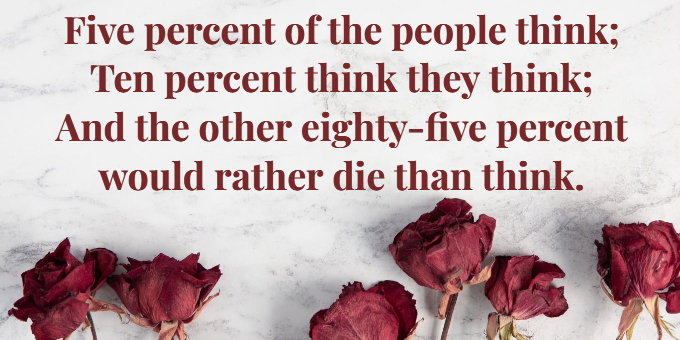
This observation, attributed anecdotally to inventor Thomas A. Edison, conveys the author’s disdain for intellectual laziness. One can only imagine what he might have said had he lived to see the rise of artificial intelligence (AI) and its influence as it is playing out today. With AI seeping into every nook and cranny of modern life, it’s never been easier for people to let someone or something else do their thinking for them, offering instant, effortless improvements in “their” creative output.
Just for fun, I asked a chatbot to weigh in on how AI is dumbing us down. Here’s a portion of its reply:
Humanity has long exhibited a natural disinclination toward rigorous thinking—a tendency echoed in aphorisms like the one attributed to Edison, suggesting most people avoid deep reflection. AI’s pervasiveness in 2026 exacerbates this inertia by enabling “cognitive offloading,” where individuals delegate reasoning, analysis, and problem-solving to algorithms, often at the expense of independent thought. This isn’t mere convenience; studies reveal a direct correlation between frequent AI use and diminished critical thinking skills, with users showing reduced ability to evaluate information, question assumptions, or engage in reflective problem-solving.
A 2025 study of 666 participants confirmed that heavy AI reliance correlates with weaker reasoning and argumentation, mediated by offloading. In professional settings, “workslop”—low-quality AI-generated output—highlights how blind trust in AI stifles creativity and ethical scrutiny, with users perceiving less effort but demonstrating less critical engagement. Broader societal risks include amplified biases from algorithmic filtering, reduced skepticism, and a visible decline in brain performance as people transfer cognition to machines. Cognitive fatigue further mediates this, as dependence on AI saps the motivation for independent effort.
How do we know what’s true and what’s false, what’s real and what’s not? How do we know at all?
There are three gateways through which we acquire knowledge: rationalism, empiricism, and faith.
Rationalism involves our thought processes, the realm of reason and ideas, our use of words to form and express thoughts, governed by the laws of logic.
Empiricism involves the sensory world, which we may observe and experience by means of our senses and experimentation, governed by the principles of science and induction.
Faith is simply believing something; it occurs prior to—and is a necessary precondition of—both rationalism and empiricism.
Thinking requires a vocabulary; words are the building blocks of thought. The greater one’s vocabulary (all other factors being equal), the greater his ability to think with precision. But before we began to form thoughts by combining words into phrases and sentences and paragraphs, we first had to exercise faith. We believed (accepted as true) when our parents identified themselves as “mama” or “dada.” When we were ready they taught us the alphabet, the building blocks of words. When they said, “This is an A; this is a B; this is a C,” we accepted what they said as true. Faith was prerequisite to learning the alphabet and acquiring the vocabulary by which we eventually could verbalize thoughts and ideas.
Likewise, to make use of empiricism we must first believe that our senses are accurate and reliable, that the physical world is real and not an illusion, that the laws of the physical realm (e.g., gravity) operate with consistency, that there is a direct relationship between cause and effect. Only by assuming these truths by faith can we proceed in confidence with our experimentation.
So, we must acknowledge that we were not born with knowledge, only with the capacity to acquire it, to learn. But go back, and back, and back some more. Go all the way back, thousands of years, until you can go back no further in human history, back to the very first human being to exist.
Where did his knowledge come from?
“In the beginning, God.…”
The Bible tells us who we are, where we came from, why we are here, and what this is life all about. And it starts with God who made us. Fortunately, He did not leave us in the dark to speculate. He chose to reveal Himself to us. He is the source of knowledge and truth.
In the beginning, God created the heavens and the earth. (Genesis 1:1) As C.I. Scofield observed, the Bible begins with God, not with philosophic arguments for His existence. First and foremost, we must presuppose that the God who created us is the only One who knows us truly and exhaustively.
In Genesis 1:27 we read that God created us in His image. This means that He made us personal, sentient, rational, communicative, and relational beings. He gave us volition, the ability to make choices, and conscience or moral consciousness, making us responsible for our choices.
You want to know what you’re really like? Trust God to tell you with perfect accuracy. Because He (and He alone) knows you exhaustively—and loves you better than you love yourself. Read Psalm 139 and you’ll see.
Only God is omniscient; He knows everything about everything. God knows all things past, present, and future; actual and possible; He knows all the variables, all the “what-ifs,” and in His word He has entrusted to us a portion of all that He knows, all that is necessary for us to function as we were meant to. Being finite and fallible, we humans cannot know exhaustively—but we can know truly.
God has not left us alone to grope about in the dark for answers. According to Psalm 19, God has revealed Himself to us in nature (general revelation, vv. 1-6) and in words (special revelation, vv. 7-11), so that we cannot in honesty plead ignorance of Him (vv. 12-14; cp. Romans 1:20 and Ecclesiastes 3:11).
PSALM 19
The heavens declare the glory of God;
And the firmament shows His handiwork.
2 Day unto day utters speech,
And night unto night reveals knowledge.
3 There is no speech nor language
Where their voice is not heard.
4 Their line has gone out through all the earth,
And their words to the end of the world.In them He has set a tabernacle for the sun,
5 Which is like a bridegroom coming out of his chamber,
And rejoices like a strong man to run its race.
6 Its rising is from one end of heaven,
And its circuit to the other end;
And there is nothing hidden from its heat.7 The law of the Lord is perfect, converting the soul;
The testimony of the Lord is sure, making wise the simple;
8 statutes of the Lord are right, rejoicing the heart;
The commandment of the Lord is pure, enlightening the eyes;
9 The fear of the Lord is clean, enduring forever;
The judgments of the Lord are true and righteous altogether.
10 More to be desired are they than gold,
Yea, than much fine gold;
Sweeter also than honey and the honeycomb.
11 Moreover by them Your servant is warned,
And in keeping them there is great reward.12 Who can understand his errors?
Cleanse me from secret faults.
13 Keep back Your servant also from presumptuous sins;
Let them not have dominion over me.
Then I shall be blameless,
And I shall be innocent of great transgression.14 Let the words of my mouth and the meditation of my heart
Be acceptable in Your sight,
O Lord, my strength and my Redeemer.
So, God has provided us with all this revelation, information that He alone can provide. And He has enabled us to receive it and understand it, so that we may know reality with certainty. He has given us the fundamental information we need in order to live successfully in this world. Several large portions of the Bible, most notably the books of Proverbs and Ecclesiastes, are devoted entirely to the principles of knowledge, wisdom, and understanding, extolling their incomparable value.
Wisdom is the principal thing; therefore, get wisdom. And with all thy getting, get understanding. (Proverbs 4:7)
Understanding—the word in the Hebrew is binah—“…connotes the ability to discern intelligently the difference between sham and reality, between truth and error, between the specious attraction of the moment and the long-range values that govern a truly successful life.” (Dr. Gleason Archer, A Survey of Old Testament Introduction)
Sounds like a worthy goal, does it not?
The God who created us has designed us to function on the basis of the revelation He has provided.
According to Scripture, God has created the “universe.” God has created time and space. God has created all the “facts” of science. God has created the human mind. In this human mind God has laid the laws of thought according to which it is to operate. In the facts of science God has laid the laws of being according to which they function. In other words, the impress of God’s plan is upon his whole creation.
We may characterize this whole situation by saying that the creation of God is a revelation of God. God revealed himself in nature and God also revealed himself in the mind of man. Thus it is impossible for the mind of man to function except in an atmosphere of revelation. And every thought of man when it functioned normally in this atmosphere of revelation would express the truth as laid in the creation by God. We may therefore call a Christian epistemology a revelational epistemology.
– Cornelius Van Til, A Survey of Christian Epistemology
In other words, God designed us to think like Him, to think His thoughts after Him.
He has a unique plan for each of us (Jeremiah 29:11, Philippians 1:6). And getting with that plan begins with simple, childlike faith: believing what He has told us, trusting in the veracity of God and being willing to receive what He graciously desires to provide for His children.
Which brings up an important question: Are you a child of God? How do you know? Again, the answer is found in the Bible (I John 3:1 cp. John 3:16-18, 36)
If you have trusted in the person and work of Jesus Christ in your behalf, then you have received all the resources necessary to acquire knowledge and truth (I Corinthians 2:9-16):
9 But as it is written:
“Eye has not seen, nor ear heard,
Nor have entered into the heart of man
The things which God has prepared for those who love Him.”10 But God has revealed them to us through His Spirit. For the Spirit searches all things, yes, the deep things of God. 11 For what man knows the things of a man except the spirit of the man which is in him? Even so no one knows the things of God except the Spirit of God. 12 Now we have received, not the spirit of the world, but the Spirit who is from God, that we might know the things that have been freely given to us by God.
13 These things we also speak, not in words which man’s wisdom teaches but which the Holy Spirit teaches, comparing spiritual things with spiritual. 14 But the natural man does not receive the things of the Spirit of God, for they are foolishness to him; nor can he know them, because they are spiritually discerned. 15 But he who is spiritual judges all things, yet he himself is rightly judged by no one. 16 For “who has known the mind of the Lord that he may instruct Him?” But we have the mind of Christ.
As believers in Christ, we have the opportunity (and responsibility) to think like Jesus Christ (I Timothy 2:4b), to know with absolute certainty the truth by which we may live our best life, the life God designed for us.
If you are not yet a believer in Christ, now is a good time to settle the matter and secure your eternal future with Him, as well as an abundant and fruitful life in time.
“For God so loved the world that He gave His only begotten Son, that whosoever believes in Him might have everlasting life.” (John 3:16)
“I am come that they may have life, and that they may have it more abundantly.” (John 10:10b)
“Thanks be to God for His unspeakable gift.” (II Corinthians 9:15)

 RodSpots: the Next Chapter