Imitation, the Rev. Colton insisted, is the sincerest form of flattery.
In the annals of American advertising, no slogan has attracted so many imitations—trite or inane as they may be—as the legendary Got Milk?, created in 1993 by Goodby Silverstein and Partners for its client, the California Milk Processor Board, which today owns and licenses those famous two words to other national dairy boards, merchandisers, and manufacturers.
GS&P turned to radio for its unique ability to create great theater-of-mind (and thirst-for-milk), as here: and here: Then came the white-mustached celebrities.
Over the past 18 years we’ve all seen or heard local advertisers’ pathetic attempts to coopt the “Got [Insert Product or Service]?” slogan for their own businesses. Remember any of them? Did any succeed in making themselves endearing or memorable as a result?
Of course not. They simply reminded us of milk and we forgot about them.
Just the other day, driving up to Spokane, I passed a Prius sporting a bumper sticker that read: “Got Yoga?” Do these lemmings honestly believe that their customers think of that as clever advertising?
Clever?? No, what it really communicates about the advertiser is that their marketing people are lazy. Or incompetent. Perhaps both.
If you’re in business, you have a story that belongs to you and no one else. Tell that story, your story, instead of borrowing someone else’s and trying make it fit you.
Here is a one-word reason advertisers should give serious consideration to participating in their radio commercials:
originality.
Each of us is, in the strict sense of the word, unique. An original, not a clone.
As a business owner/operator, your role as a spokesman for your business is also unique.
Although some advertisers are able to take a radio commercial script and make it theirs, others find it difficult to read convincingly from the printed page. Fortunately, it is not necessary that they be able to do so in order to create compelling commercials featuring their own voice. Listen to this example of a local “original,” sent to me a few years back by a client who runs a radio station in a small Missouri market: Tell me you didn’t wish, if only for a moment, that you could sit down to one of Maxine’s home-cooked dinners!
One of my favorite longtime local advertising clients manages a wine, beer, specialty foods shop in Moscow, ID. Terry has been the voice of his commercials for many years, though I’ve never had him read from a script. Rather, I engage him in conversation about the product(s) in question and record his responses. Here’s a commercial typical of his approach: Terry sounds like an expert because he is one. Wine Company customers frequently seek his advice on wine or beer pairings with a particular food, and all would agree: he knows his stuff.
Personalization makes such a huge difference in an advertising campaign, its importance cannot be overstated. Geico Insurance is one of radio’s biggest spenders. Most listeners are familiar with Geico’s slogan (“Fifteen minutes could save you hundreds on car insurance.”) and the distinctive voice of its spokesman. But who is he? Do we know him? Do we really care about him? By contrast, here’s another popular radio advertiser with a distinctive slogan. The difference is, we know their spokesman by name. For twenty years, he’s been dropping by to chat with us, leaving us with a smile and a promise. And what an impression he’s made!
Originality. There’s nothing like it.
Especially when it comes to building your brand on radio.
I’ll admit there are advertisers who should be discouraged from doing their own radio commercials. (Here I would love to insert a few perfect examples, but let’s be charitable.)
Still, my tendency is to err in the direction of giving the client a try at it, at least, before deciding to go in a different direction, because:
1) Client-voiced commercials are distinctive. The client is unlikely to be mistaken for any other voice, personality or advertiser on the air.
(2) The authority and expertise of the spokesman adds to the credibility of the message.
(3) Over time the advertiser becomes a familiar voice, no longer a stranger even to listeners who have yet to patronize his business.
(4) And yes, the client is more likely to have people mention hearing the ad. What’s wrong with that? If it makes his investment in Radio more tangible, that’s terrific.
Writing ad copy for clients to read requires fine-tuning to fit their personality, vernacular and style. Be prepared to edit or even rewrite copy on the fly, i.e. during the recording session. Also, most clients need coaching and feedback, requiring equal measures of persistence and patience. It can be frustrating for both parties to have to do 15 or 20 takes to get everything right. Stay focused on the objective: an effective commercial that will stand repeated listening.
What about advertisers with pronounced accents?
Avi, the Good Deal Guy
Meet Avi Levy. Avi purchased a floor covering store back in 1992, the same year I purchased my present home. I bought a houseful of carpeting and other floor coverings from him and he became a regular radio advertiser for many years. From my experience as his customer I picked up on a phrase he was fond of using: “Don’t worry—I’ll make you a good deal.” So, it was only natural to cast him in his own commercials as Avi, the Good Deal Guy, which caught on immediately and stuck fast.
Avi was born in Morocco and grew up there and later in Israel. He was fluent in French, Hebrew, Arabic (in recent years he’s added Chinese to the mix)…and English. Well, sort of. Between his pronounced accent and occasionally stilted pronunciations, conventional wisdom would have suggested letting someone else read his commercials. But one man’s drawback is another’s challenge, as Inspector Clouseau might say it, and I hoped that Avi’s distinctive approach would work to his advantage in a radio campaign. My favorite line in the spot is where Avi urges his prospective customer to use that tried-and-true tactic for postponing a buying decision, Let me think about it…on his competition!
Although Avi left the airwaves years ago as he migrated away from local retail into international wholesaling, people in the market still remember his commercials, still refer to him as Avi the Good Deal Guy.
Here’s another successful radio advertiser whose distinctive individual style—obviously ethnic, a little rough around the edges, and in-your-face—creates a compelling commercial for his Las Vegas-based company: (Thanks to one of my favorite radio people, TalkRadio Guru Holland Cooke for passing along Mr. Elliot’s spot.) Honestly, don’t you find yourself wishing there were a 24/7 Private Vaults branch near you?
Not every client is comfortable reading from a script. But even those who for whatever reason can’t read or even ad-lib well from the printed page may still find a way to participate meaningfully and effectively in their own radio commercials. I’ll share some fun examples of this next time.
Advertisers who voice their own radio commercials often find it a powerful way to leverage their knowledge and expertise, their accessibility, even their personalities to competitive advantage.
After all, as owners their words carry more weight. They are the local experts in their business or profession. Theirs is the voice of authority.
Their additional investment of time and effort in voicing their own commercials multiplies the value of the dollars they’re spending, compounding the effectiveness of their advertising.
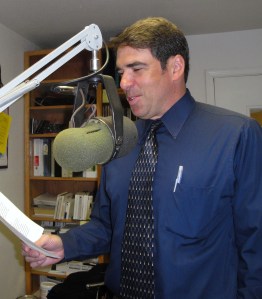
Here’s an example of one optometrist’s skillful use of radio:
Over the past 12 years or so, Dr. DeVleming has answered hundreds of questions in his radio spots, which run on a daily basis every week of the year, with copy changes every 3 weeks.
When we first put this campaign together, the objective was to establish the good doctor as the local authority or expert on eye care. His decision to close his spots with “talk to your eye care professional” instead of “come into my office” might seem counter-intuitive, but actually has worked to his advantage. It confers his radio messages with an aura of objectivity and professionalism that lifts them above the usual “ad speak” and gives them greater authenticity. So, even though these are paid radio commercials for his business, they don’t sound like it!
How has this campaign worked for Dr. DeVleming? He says that “new business alone” more than pays for his advertising. His name and practice are widely known and his business is thriving.
This approach, the advertiser-as-expert, represents a tremendous opportunity for radio stations and radio advertisers to collaborate profitably on exciting, effective, long-term advertising campaigns that engage listeners and turn them into customers. Recently a radio station client in Michigan shared a successful campaign he’s been doing for an advertiser whose specialty is dermatology. Good stuff. And there’s the restaurant guy in Arizona whose folksy spots and homespun wisdom have made him a local celebrity.
Over the years I’ve had the privilege of working with professionals in diverse fields—dentistry, podiatry, accounting, real estate, automotive service and repair, even house paint and painting supplies—who have found that by becoming their own spokesmen, they’ve created distinctive and effective advertising campaigns. But that’s not all.
They’ve also become the dominant players in their category.
I create radio advertising campaigns for a living. Words are the tools of my trade.
Words give wings to ideas and make them soar.
Words move people, products, and services.
Words turn strangers into customers, and customers into evangelists.
But the words we speak convey only part of what we mean; how we speak them conveys a great deal more.
For instance, take this short piece of advertising copy from a previous post:
“You can afford to have your wedding at the Davenport. TheDavenportHotel.com/weddings.”
How would you read that spot? (Just for fun, take a moment to read it aloud, just as though you were recording it as a radio spot. You’ll understand why momentarily.)
At first glance, my tendency would be to emphasize the word can. Everyone knows that The Davenport Hotel is a posh place, elegant and expensive. A bride on a budget might be inclined to dismiss it as a venue choice, assuming it to be financially out of reach. That’s the stereotype the Davenport hopes to overcome. Miss-Bride-to-Be, you CAN afford to have your wedding at the Davenport!
But wait. Another voice talent looking at the same script might focus on the word your: (“Yes, it’s true that some people aren’t able to afford the Davenport, but YOU can. And it’s YOUR wedding. So, why not choose the best?”) You can afford to have YOUR wedding at the Davenport!
To illustrate the diversity of meaning that different voice talents might distill from the same words on paper, I enlisted the aid of eleven friends across the country, accomplished voice actors and talented radio producers, each reading the same short spot for the Davenport.
Diversity, indeed.
Good radio advertising—which is to say, effective radio advertising—begins with a good script.
But it doesn’t end there.
Somebody has to snatch those words off the printed page and breathe life into them, infuse them with personality, with meaning that engages the listener and triggers the appropriate emotional response that will lead to the desired result. This is the job of the voice talent, and, as you’ve just heard, no two sound exactly alike.
By taking time to audition a number of voice talents on the same script, you have the opportunity to hear and compare their interpretations. You might discern different shades of meaning or nuances of emotional engagement that were not previously apparent.
In the higher echelons of advertising and entertainment, producers hire casting directors to help choose the best spokesman for the brand, the right actor for the role.
Much further down the food chain, at the level of local radio in small and medium markets—where budgets are smaller and everyone wears several hats—little thought and even less money are directed toward casting talent for radio commercials.
Whether you’re a radio advertising salesperson, station manager or owner, or a radio advertiser trying to grow your business, if you agree with my premise, that the choice of voice can have a significant impact on outcome of your commercial or campaign, and if (as a station rep) you understand that the best and probably the only sure way to keep your advertising clients committed to your station is to provide them with commercials that bring a return on their investment, then perhaps it’s time to reconsider your approach to choosing voice talent.
You DO have choices—affordable choices—beyond the overbooked and overexposed production staff at your radio station. Here are a few to consider, that are either free, relatively inexpensive, or that cost-a-little-more-but-your-client-is-worth-it:
1) Look for talent in unexpected places. You may be surprised at the quality of latent talent available right in your own little corner of the world. They may need a little coaching or cultivating, but they’re capable of quality work. Darci, the bank teller, ended up doing a couple of Mercury-finalist spots for me.
2) Consider talent exchanges with radio stations in other markets. Several members of Radio Sales Café (a free networking site for radio advertising sales professionals) have been actively involved in facilitating such exchanges over the past 18 months, with participants working strictly on an informal barter basis.
3) Another good bet is Radio and Production magazine’s website, which offers producer forums and classifieds. I’ve seen more than one solicitation there to trade production work.
4) Seek out radio production companies that offer “bulk production” services on a subscription basis. One such company is Randy Lawson Productions, based in Indiana. Randy’s talent roster includes 17 voices, mainly from radio though some have backgrounds in theater. For a monthly retainer of $195, stations can have up to 20 spots produced by their choice of talent; $295, 30 spots; $395, 40 spots. Àla carte production is $15 a spot.
5) You can set up free account at Voice123.com, Voices.com , and similar sites that provide matchmaking for voice talents and businesses needing their services. As a voice-seeker you post your project, specify the amount you’re willing to pay the talent, and how many auditions you’re looking for. Voice talents who meet your criteria receive information on your post, and those interested send their auditions directly to you. More than a few people I know have likened the process to a cattle call. With nearly 200,000 registered voice talents on the leading site alone, you can bet there are more voices available than there is work to keep them all busy.
6) If you have the time and inclination to delve deeper, you can do a Google search on “voice talent” and put on a large pot of coffee. Many voice artists, union and non-union alike, have hung their shingles on the world wide web, with distinctively branded websites, online demos, and accolades from satisfied clients.
Expect to pay more for the services of well-established voice actors, commensurate with their talent and the benefits that attach to it. That said, don’t automatically assume that high-profile talent is beyond your means. Negotiation comes with the territory. If you hear a voice you think would be perfect for a particular project, contact the talent. Be upfront about what you expect and what you’re prepared to pay. They may decline your offer or they may accept it. But you won’t know until you ask and most voiceover pros that I know would prefer to be asked than not.
“Advertising is fundamentally persuasion and persuasion happens to be not a science but an art.” – Bill Bernbach, from a May 15, 1947 letter to the owners of Grey Advertising, his soon-to-be-ex-employer
Words and voices. The art of persuasion. Radio advertising.
Now we’re talking.
________________________________________
My sincere thanks to the eleven gentle souls who graciously lent their considerable talents to this article: Tim Burt, Scott Chasty, Rowell Gormon, Bruce Martin, Scott Nilsen, Perry Anne Norton, Rich Owen, Blaine Parker, Bob Souer, Natalie Stanfield Thomas, and Brian Whitaker.
When it comes to promotions, I’m a big believer in keeping things simple – especially in this age of the 11-second attention span.
Here’s a promotion any radio station or advertiser can put together easily and at minimal expense.
Its appeal is universal.
Can you say: Happy Birthday!
Take the total population of your market, however you may define it—whether your city, county, region, customer database, or what-have-you—and write it down.
Divide that number by 365.
The result equals the average number of birthdays taking place in your market every day.
Yes, the actual number will be lower on some days and higher on others. But the point is, each and every day represents an opportunity to wish your listeners or customers a Happy Birthday.
It’s easy enough to start your Birthday Club. Simply invite people to register via email, a form on your website, your Facebook page, or whatever. Be sure to collect at minimum a name, email address, and date of birth; mailing address and telephone number are also desirable for building a useful database.
Each day you publicly recognize the people whose birthday it is. If you’re a radio station, mention them on the air several times throughout the day. Congratulate them on your Facebook page (and theirs), in your Twitter feed.
Add to the fun by drawing at least one name each day to win a birthday prize: a cake, a birthday meal, a special gift, etc. – traded in whole or part with advertisers who help sponsor the promotion.
If you’re in a business other than radio, use all the means at your disposal to recognize your customers’ birthdays. Design a “Happy Birthday” whiteboard or print up sign to post prominently near the door, in a window, at the service counter, or behind the till where everyone can see it. Maybe put up a community bulletin board for this purpose.
If you can afford to send a hand-signed card, do so. If you have an email address, you can send an e-card. Dayspring, Hallmark and many others offer them. My personal favorite is Jacquie Lawson, a British artist whose intricate and whimsical e-cards are little works of art; the cost is just $12 a year!
Consider offering a free meal, a special birthday discount (make it meaningful) or a small gift—a Happy Birthday balloon or candy bar—even the littlest things can leave big impressions. I used to go to a dentist who had carnations delivered to his office each day. Every patient went home with one, and it lasted in water for at least a week, a fragrant reminder that the family dentist had a heart. The cost was minimal; the delight factor, huge.
One of the members of Radio Sales Café, “Jingle” Jim Reilly, sends his clients and prospects an email on their birthday. When the recipient clicks on the link as requested, singers start singing a special “Happy Birthday” jingle.
Want to surprise and delight each and every one of your customers? Start your own Birthday Club and watch their faces light up as brightly as the candles on their cake.
You have to admit, this does not look like a typical newspaper ad:
This ad has been running recently in The (Spokane, WA) Spokesman-Review — not in the classifieds, as the image above might suggest, but in the first section of the paper, on pages 2 or 3.
It’s an eighth-page ad consisting of one sentence, set in 48-point type, followed by a website and telephone number.
There are no pictures of the hotel, no graphics, no logo.
Just words-on-paper, the imitation of human speech.
This ad was made for radio.
But I wonder how many radio advertising salespeople in Spokane have approached The Davenport Hotel with a proposal to put this message on the air, as-is. No recommendation to dress it up. No attempt to mess with it. No suggestion that it be turned into a :30- or :60-second commercial.
Just the simple, clear proposition:
“You Can Afford to Have Your Wedding at the Davenport.
TheDavenportHotel-dot-com-slash-weddings.”
Let’s give the marketing folks at The Davenport credit for knowing what needs to be said and what can safely be left to the imagination.
The fact is, everyone in Spokane is familiar with The Davenport—just as Parisians are with their Eiffel Tower. The Davenport Hotel is a local icon of opulence and hospitality, a landmark hotel famously restored and reopened in 2002 to widespread acclaim.
And therein lies its marketing challenge, if one is to take their ad at its face value, to inform and then remind brides-to-be that while The Davenport Hotel indeed is a luxurious venue for a wedding reception—it also is surprisingly affordable!
So, they’ve nailed the message.
But will that twenty-something bride-to-be even see their ad in the newspaper?
Not likely.
Her parents or grandparents may see it, but she won’t. Because newspaper isn’t a young person’s medium, especially these days.
So again I wonder, who among Spokane’s radio advertising sales pros, especially those whose stations target young women, will rise to the challenge and offer to help The Davenport Hotel by putting their simple, straightforward sales message on the air—without embellishment—two or three times an hour, every hour, all day long? For such a campaign would surely serve The Davenport’s interests, while demonstrating to them the unique power of a short ad on radio.
Advertising dollars are scarce in the best of times. Competition is always fierce. But in today’s economy, can any businessperson afford to squander his limited advertising budget?
You wouldn’t think so.
There have never been more places for advertisers to gamble with their ad dollars. Those who are attracted to novelty (“the grass is greener”) are especially vulnerable to salespeople with a new gimmick and a slick pitch. The sheer number of competitors for local ad dollars is matched only by the mind-numbing stupidity of some of these new alternative forms of advertising.
For instance, over the past few years I’ve watched and winced at the efforts of one company whose business is selling video ads—visual display only, no speech or sound—that run on video monitors mounted on the wall of a grocery store opposite the check stands. I’ve seen these things in stores throughout the region, including my favorite local supermarket here in town.
Nothing wrong with these stores. They’re simply providing space and receiving compensation for hosting the monitors, which are operated and maintained by the ad company. For the supermarket, it’s just good business—leasing a little space to a third party helps pay the bills, while providing a service to their customers, whether it’s a Redbox DVD dispenser, a Coinstar machine, or a carpet cleaner rental depot.
But my interest in this particular enterprise is that of a working advertising professional. I note and observe these things with a critical eye, always wondering, How’s this working for the advertiser, compared to alternative forms of advertising?
The video monitors are mounted eight feet or so above the ground, spaced 20 or 30 feet apart at the end of the checkout lanes (see photo below).
I’ve stood around paying close attention to see if anyone even glances at these things, let alone watches them long enough for an impression to register. Drives me crazy to see all the advertisers they’ve bamboozled, including a few regular radio advertisers but more than a few who have never spent a dime on radio. Isn’t anybody calling on them?
Here’s a view from the vantage point of Suzy Shopper, the captive consumer, standing in line waiting to be checked out. Presumably, instead of watching her groceries being scanned and rung up by the checker, while engaging in a brief, pleasant verbal exchange, Suzy’s head will turn 90 degrees and her eyes will be fastened upon the monitor, as she checks out all the wonderful ads. (Assuming it’s turned on. It’s been dark on more than one occasion.)
Some of the advertisers who’ve bought this package did so on the basis of a telephone pitch; others had the privilege of visiting with the salesperson face-to-face. Either way, they sign up for a 3- or 6-month contract and wait for the results to come flooding in.
And wait.
And at the end of the contract, they bail.
Based on my observation over the past three years or so, and corroborated by advertisers I’ve talked to about their experience, the renewal rate appears to be: ZERO. No measurable response, no return on investment…no renewal.
It’s painful to think about all the ad dollars that have been wasted on this garbage “medium.”
However, at the very least it provides an opportunity for a conscientious Radio advertising professional to help a business in dire need of better advice. What similar opportunities exist at this moment in your market?
If you’re in the business of selling radio advertising these days, you’re presumed to be in the business of providing solutions to your advertisers’ business problems—increasing traffic, creating awareness, helping to ring the till.
Looking for someone to help? Start talking to any business you see spending money on:
Newspaper display ads
Classified ads
Newspaper inserts and flyers
Weekly “shoppers” and other print publications
Cable TV
Broadcast TV
Magazines
Billboards
Mobile phone ads
Email coupons
Sports programs
Sports pocket schedules
Sports schedule posters
Concert/Event programs
City maps
Concert programs
Yearbooks
Backs of tickets
Bumper stickers
Direct mail
Door hangers
Yellow Pages ads
White Pages ads
Website banners
Search ads
Sponsored links
Bus stop bench ads
Airport panel ads
Hotel window boxes
Mall kiosks
Supermarket video displays
Movie theater ads
Bowling alley score-sheet ads
Restaurant menu ads
Advertising specialties (pens, key chains, etc.)
Undoubtedly I’ve only skimmed the surface. What other competitors have you run into in your market? Please feel free to share them by means of the Comment function below.
My friend Phil Bernstein in Portland, OR – a former Clear Channel superstar and now a road warrior with Jim Doyle & Associates sent me these:
-signs in the men’s room
-urinal cake advertising (really!)
-bill stuffers
-airline tray ads
-ticket back advertising
And in typical Phil fashion, he added: “And our single biggest competitor … doing nothing.”
Amen.
With this post, my radio advertising blog has moved from its former location to this more robust WordPress platform. If you create, sell, or invest in radio advertising for your business, I welcome your readership and participation. Thanks for visiting! -Rod



 Here’s an example of one optometrist’s skillful use of radio:
 One of the definitions of elegance is simplicity.


 RodSpots: the Next Chapter