
 Over the past few years the guys at


Search RodSpots
-
-
Recent Posts
Categories
- Advertising (General)
- Artificial Intelligence (AI)
- Awards
- Bible
- Branding
- Business
- Casting Talent
- Client-voiced commercials
- Communication
- Consistency
- Consultants
- Consumer behavior
- Copy
- Copywriting
- Demonstration (demo) tapes
- Ginger Beer
- God
- Got Milk?
- Grace Broadcast Sales
- Graphic design
- Information overload
- Internet
- Jingles
- Life lessons
- Madison Avenue
- Magazine
- Management
- Newspaper
- Ogilvy
- Paul Harvey
- Pay-per-click
- Political advertising
- Positioning
- Problem-solving
- Procrastination
- Productivity
- Professional Services Advertising
- Promotions
- Proofreading
- Radio Advertising
- Radio Commercials
- Radio Copywriting
- Radio Production
- Radio Sales Cafe
- Recruitment
- Rush Limbaugh
- Sales
- Sales & Marketing
- Shop Local
- Slogans and taglines
- Storytelling
- Uncategorized
- Voice Acting
- Voiceover
Advertising to Make You Smile
Posted in Advertising (General), Branding, Client-voiced commercials, Communication, Consumer behavior, Copy, Copywriting, Positioning, Promotions, Radio Advertising, Radio Commercials, Radio Copywriting, Radio Production, Sales, Sales & Marketing, Storytelling, Uncategorized
Tagged appliance, April 1, April Fool, Commercial, creativity, Howard Hughes, humor, imagination, Radio, television
Leave a comment
Effective Advertising and the Law of Exclusion
 Your business is defined principally by what-you-sell or what-you-do. Are these the only things you talk about in your advertising?
May I suggest that you are also defined by what you won’t do or sell, by what you exclude.
The principle of exclusion conveys that you’ve drawn a line in the sand, and you stand on just one side of it. You don’t try to straddle both sides. You’re not all things to all people.
The contrast sets you apart. It helps consumers to understand with greater clarity what your business or brand is all about. Those who identify with you are more likely to do business with you.
Here’s a great example:
Carl owns a repair shop called Imported Car Service (ICS). He specializes in servicing, maintaining, and repairing imported cars. Over the years, Carl has recorded dozens of radio commercials, most of which have been written to provide his customers with valuable tips and tricks to add to their driving pleasure and to help reduce their cost of ownership.
But this spot does something else. It tells owners of domestic brands that ICS isn’t interested in working on those particular vehicles, because all of their time, effort, and infrastructure is poured into serving the needs of import car owners. Telling you what they won’t do makes their advertising more credible and effective, as Carl himself will tell you.
_____________
We’ve had a lot of dark skies and rain in recent weeks. When there’s a sliver of clear sky in the west at sunset, the rays of the setting sun seem to intensify, casting a fiery glow on objects underneath the canopy of dark clouds. This view of the WSU skyline caught my attention on just such an evening. If the light had been evenly distributed overhead the scene wouldn’t have been as interesting. But set against a backdrop of darkness (the exclusion of light), it really pops.

Just like your advertising, right?
For those who read to the end, a gift.
Advertising and the Two Gateways to the Brain
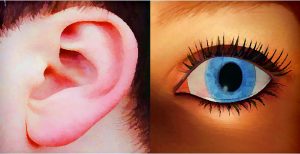 Which is more powerful, the eye or the ear? If you could keep just one of these two senses, which would you choose?
Strange questions to ask, but stay with me for a moment.
We don’t give much thought to our senses; we just use them. Hearing, sight, smell, and touch all affect how we perceive our environment and the people with whom we interact.
In advertising, we’re concerned primarily with the first two, hearing and sight. Which of these, if it came down to it, would you give up first?
Whenever I’ve asked this question of different people, I’ve heard both answers. But I’ve also noticed a tendency among those who answer without hesitation to say they’d give up their hearing to save their sight, while those who take more time to think about the ramifications tend to favor preserving their hearing.
Strangely, we sometimes confuse them in our everyday speech. For instance, a friend tells you about something he’s learned and you reply, “I see what you mean.” Or we see (read) something interesting on the dinner menu and say ‘that sounds good.’” Why is that?
Al Ries and Jack Trout, co-authors of Positioning: the Battle for the Mind, one of the most influential advertising books of the 20th century, conducted extensive research in an effort to learn how the human brain responds differently to ear-oriented stimuli and eye-oriented stimuli.
 The March 14, 1983 issue of ADVERTISING AGE carried the article that detailed their findings: “The eye vs. the ear.” (It was subsequently reprinted as a chapter in Jack Trout’s excellent follow-up book, The New Positioning.)
“Written language,” they said, “is recoded by the mind into an internal form of oral language. It seems that your mind must translate printed words into their spoken equivalents before it can understand them.”
Furthermore,
When people communicate with one another, the ear is the preferred avenue of entry, either in person or over the phone.
When people turn to one of the senses for pure pleasure, the sense they generally turn to is the ear. Compare, for example, the time spent listening to music with the time spent looking at art or photography. There’s no comparison. The ear wins by a huge margin.
What are the implications where advertising is concerned?
Clearly there is a striking inconsistency between advertisers and the target of their advertising, the prospects.
Prospects spend 85 percent of their overall media time immersed in ear-oriented media…and only 15 percent of their time with eye-oriented media such as newspapers and magazines.
Advertisers, on the other hand, spend 55 percent of their dollars on eye media (print), and only 45 percent of their dollars on ear media (broadcast).
It’s worth repeating: Consumers spend 85 percent of their overall media time immersed in ear-oriented media, and only 15 percent of their time with eye-oriented media such as newspapers and magazines.
The emergence of the Internet and new media has added more variables to the equation, but the central fact remains: the mind works by ear.
Speech remains our primary form of communication. Print, in any form, is an imitation of speech. The only pure-speech mass medium is radio.
P.S. You remember Paul Harvey, don’t you? For my money, he was radio’s most trusted voice. Got a minute and 12 seconds to hear his take on all this?
Posted in Advertising (General), Branding, Business, Communication, Consistency, Consumer behavior, Copy, Copywriting, Demonstration (demo) tapes, Information overload, Jingles, Magazine, Newspaper, Positioning, Print, Problem-solving, Professional Services Advertising, Radio Advertising, Radio Commercials, Radio Copywriting, Radio Production, Sales, Sales & Marketing, Slogans and taglines, Storytelling
Tagged Advertising, comprehension, ear, eye, memory, mind, Radio, retention, Ries, speech, Trout
3 Comments
On Radio Anything’s Possible
 It’s well established that sounds enter the brain faster than visuals, and the memory of those sounds fades more slowly. Which is why, as Paul Harvey once pointed out, as a kid in the classroom, you could answer the teacher’s question, “What did I just say?” accurately, even though you’d been daydreaming and your thoughts were a million miles away moments before.
Speech is mankind’s primary form of interpersonal communication. And radio, because it is the only pure audio medium, is the most intimate and personal of all advertising media.
Radio also happens to be the most visual of all media.
Say what?
It’s true. Pictures in the mind are more vivid, more personal, and therefore more “real” to us. And they’re unique. A hundred people can read the same book, but each will have different pictures of the people and places described in the story.
These things came to mind as I watched the video accompanying the Call for Entries to this year’s Radio Mercury Awards (radio’s counterpart to the Oscars).
Wasn’t that fun?
Wait a minute, you say. Aren’t you contradicting yourself? That’s a video.
Of course it is.
But when there wasn’t a picture on the screen, you were still seeing something quite vividly in your mind!
That’s the power of pure audio. That’s the power of radio.
Still unsure? OK, click the play button below and close your eyes.
Makes the point, doesn’t it?
Produced by WBEB-FM in Philadelphia, that commercial won the 2010 Radio Mercury Award in the Station Produced category. (Six years earlier, I’d been honored with the same award for a spot I’d created for Keeney Bros. Music Centers, entitled “Dreaming.”) What many Radio Mercury-winning spots* have in common is that they’re entertaining, captivating, and visual.
Whether your goal is long-term brand-building or short-term cash-register-ringing you need, you really ought to explore what radio advertising can do for you. If you’d like to learn more, give me a call
*Want to hear some of the most engaging radio commercials ever produced? Check out the Radio Mercury Award winners archives. You’re welcome.
Posted in Uncategorized
Tagged Advertising, brain, engaging, media, Mercury Awards, mind, pictures, Radio, speech
2 Comments
Political Advertising: Radio Wins the Vote
 This is the story of how one political candidate harnessed the power of radio advertising to win a competitive election.
Following the death of Washington State Representative Steve Hailey, a former state legislator, Don Cox, was appointed to fill his seat. Cox chose not to run for the open seat in the next election, but five other candidates threw their hats into the ring, one Democrat and four Republicans, among them Hailey’s widow Patricia (“Pat”) and Pullman resident Susan Fagan.
The primary election was to be held on August 18, 2009. Washington being a vote-by-mail state, ballots were sent out at the end of July, giving voters several weeks to make their choice. One of the quirky and somewhat controversial aspects of our primary election is that the top two vote-getters, regardless of party affiliation, advance to the general election.
I was drafted to handle the radio advertising for Susan Fagan’s campaign. My recommendation was to start early and advertise consistently. Given the size of our sprawling district – larger than the state of Connecticut – we had several radio markets to cover. The plan was to introduce the candidate, her background, and her qualifications to voters, and then to build the campaign around the endorsements of people throughout the district who knew her and supported her candidacy.
I did not want to use prepared scripts and risk having the individuals sound stilted and artificial, which is often the case when asking people to read from a printed page words that are not their own. Rather, I chose to interview – in person or over the phone – the people whose recommendations might resonate with voters. Most of these interviews lasted from ten or fifteen minutes though some took considerably longer. I’d prepared a list of questions to keep the conversation focused and to elicit meaningful answers, but we kept the conversations open enough so that each individual would feel comfortable sharing his or her thoughts spontaneously and naturally.
As experienced producers know, the greatest challenge and real work is in the editing, deciding which ideas, words and phrases to keep, which ones to leave out, and how best to combine them for clarity and punch. It’s painstaking and time-consuming, often involving hours of work to create a single one-minute spot. But it’s an investment that makes all the difference when it comes to the end result.
We created seven commercials for Susan Fagan’s primary election campaign, considered to be the more important of the two elections because of the number of competitors for the final ballot. The messages went through several revisions and refinements, based on input from Susan and her campaign staff. We aired them sequentially, each running exclusively for several days before being replaced by the next.
Here are three commercials from the series:
Susan Fagan ended up cinching the top spot by a comfortable margin over second-place finisher, Pat Hailey.
One of the ironies of the outcome of this primary race (to me, anyway) was that the candidate who theoretically should have conducted the most effective broadcast campaign, given his background in television journalism, his current position in marketing and communications, and his campaign promise to be, in his words, “your communications warrior” came in a distant fifth of the five candidates. He did his own radio spots, in which he sounded quite confident (some thought maybe even a bit cocky) that he was the man for the job. But his strategy, as embodied by his radio schedule, proved anemic. He ran ads on just two days of the entire campaign: the day the ballots were received in the mail, and again several weeks later on the Monday before the election. By contrast, the top two contenders’ radio campaigns ran throughout the period.
Ultimately, Susan Fagan’s reliance on relentless radio advertising proved the best overall plan. Her main competitor acknowledged as much to the Daily Evergreen newspaper:
Pat Hailey, republican candidate for the 9th District House position, said Fagan is likely in the lead because she spent more money and had an extensive radio advertising campaign.
That November, Susan and Pat squared off in the general election, to determine which of the two would serve for the remainder of Steve Hailey’s term, one year. Susan again relied on radio advertising for her general election campaign. Susan’s message was simple and and straightforward. If she prevailed in the general election, it would be for a one-year term, after which she’d have to campaign again:
“One year from now, you’ll have a chance to evaluate my performance and either hire me for a full 2-year term or send me packing.”– Susan Fagan, candidate for Washington State Representative, from one of her 8 radio commercials prepared for the general election.
She went on to win that election and the following year ran unopposed for the full two-year term. Susan again ran without opposition in the 2012 and 2014 elections.
Susan and her campaign committee were unanimous in their conviction that it was her radio advertising, more than any other single factor, that helped her reach and engage voters, leading to the outcome of the race in her favor. Winning those first crucial elections gave her the opportunity to live up to her campaign promises and Susan went on to serve with distinction until her departure from the legislature in 2014*.
Someone responding to this story on another site asked why we thought radio was particularly effective for Susan’s campaign. My reply was as follows:
1) Radio is pure audio. It allows advertisers to leverage our primary form of communication, human speech, with all its emotional depth and conviction.
2) Radio is intrusive. We hear – even when we’re not listening. “God’s gift to radio is that people are born without ear lids.” – Tony Schwartz (Paul Harvey noted this, as well.)
4) Radio provides the most affordable frequency in broadcast advertising, and its ROI is superior to that of television. Radio enables an advertiser to reach his prospects repeatedly and over an extended period of time.
5) People are social creatures. We value the opinions and recommendations of others (witness our reliance on user reviews and ratings for a host of purchases). Employing the variety of testimonials conveyed the idea that many knowledgeable people throughout the district were impressed by Susan’s track record in previous endeavors.
6) Websites, blogs, and social media allow a radio advertiser to continue the conversation at greater length and in greater depth. I always recommend when appropriate that my clients use radio to drive traffic to their websites, where visitors can engage them at their convenience any time of the day or night. Radio + website/blog is the most powerful combination in local advertising today, in my experience.
*Susan Fagan’s subsequent resignation from the legislature in 2014 amid allegations of financial improprieties is not germane to this post. Suffice it to say that many local Republicans who know Susan well and are familiar with the machinations of party politics felt she was maliciously railroaded by members of her own party.
________________
Rod Schwartz backed into a lifelong career in radio advertising in 1973 in Springfield, Illinois. He joined the Pullman (Wash.) Radio Group in 1979, where he worked until his retirement at the end of 2022. From 1991 to March 2024, Rod and his family operated Grace Broadcast Sales, providing short-form syndicated radio features to radio and TV stations across the U.S. and Canada. Rod currently operates an independent advertising, marketing, and media consultancy for radio stations, small business owners and professionals, and continues providing syndicated radio features to clients. Find him at RodSchwartz.com. An avid photographer, Rod shares some of his favorite images of the Palouse at PalousePics.com and on his Viewbug gallery.
Posted in Uncategorized
Tagged campaign radio, election advertising, political, Political advertising, political radio, Radio, testimonial
Leave a comment
DON’T Use That Song in Your Commercial

I was recently asked for a favor: to provide a short voice-over for a video intended for presentation at an upcoming trade show, in exchange for dinner and wine for four at a swanky restaurant, worth around $200-250. We live in a small town and the business owner was under a time crunch, so I drove to his office to have a look at his project.
A few minutes later I walked out, having declined the job
The script they wanted me to read was (with the exception of one word substituted for “farmer”) a word-for-word ripoff of Paul Harvey’s famous “So God Made a Farmer” speech to the FFA, which reached a wider audience a few years ago as a Chrysler commercial for the Super Bowl.
Of course, it was a great piece of copy. Paul Harvey was a master of wordcraft.
But it wasn’t theirs to use.
I asked the individuals if they’d obtained permission to use the copyrighted script. Obviously, they hadn’t. A short while later I received a text saying they were scrapping the project. But they’d already used the same script at least twice before, for different corporate video presentations. The regional media and marketing company that produced the video should have known better, but evidently didn’t know – or didn’t care enough to give it a second thought.
To put it plainly, using someone else’s copyrighted material in your advertising is illegal and unethical.
Whether it’s a photograph you’ve snagged off the internet to use on your website or a hit song you’d like to use in a radio or television commercial, if it’s copyrighted intellectual property, you can’t use it legally without going through proper channels to license it for this purpose — a cost-prohibitive situation for all but the very deep-pocketed national advertisers.
A number of radio companies have been sued in recent weeks for unauthorized use of celebrity photos on their websites. In this week’s Small Market Radio Newsletter, publisher Jay Mitchell wrote the following warning to broadcasters:
How Not to Get Sued
If you’ve been keeping up, you know that no one is immune from potentially-crippling legal action from photographers and image agencies targeting websites of deep-pocketed (or so they think) broadcasting companies.News flash: It’s not just the big groups that are in danger.
While none of our radio web clients have been snagged—we monitor things like that, and as a result, they’re extremely careful—a small business client did get slammed by Getty Images for a picture that was used “FPO” (for position only) during the development phase and left up by mistake when the site went live. (That dumb mistake cost us $500, but it could have been much more.)
The thing is, you can still access pretty much every image you want or need—you just have to know where they come from, and what the usage rights are.
We all use Google to find appropriate images to illustrate our web pages, stories, and promotions. When we do, we usually enter the keywords into the search field, then click on “Images.” There’s one extra step you can take to avoid trouble. After you’ve performed your search, filter the results this way:
1. Click on “Search Tools.”
2. Click on “Usage Rights.”
3. Click on “Labeled for reuse.”
4. What now displays is probably safe to use—but you need to look more closely.The usage rights of most, if not all, of the images you see are governed by the Creative Commons licensing system. Some images, noted by “CC0,” are in the public domain and completely free of all restrictions. Others are only for noncommercial use, others cannot be altered, and some can be used only with attribution.
To find out more, you have to view the image in context—on the web page from where it came. To do this, click on an image, then click on “Visit page.” Locate your image, then click on it to display the actual usage rights. The image on this page [there was a picture of cats -RS] was located just that way; its rights are listed as “CC0 Public Domain | Free for commercial use | No attribution required”
To play it even safer, go directly to websites that participate in the Creative Commons system—some of which are Flikr, Wikipedia, Wikimedia Commons, Pixabay and Vimeo. (For more information, visit www.creativecommons.org.)
The image you want—as long as it’s licensed for commercial use—may require attribution. Play fair, give the photographer his or her due, and you’ll never have to worry about getting sued.
—Editor
Longtime radio talent coach and advertising guru Dan O’Day has written extensively on the subject of using copyrighted music in your radio advertising. (His advice, in a word: Don’t. ) But it’s such a common and pervasive problem that years ago he wrote a book on the subject, intended primarily for radio station production departments, but useful for anyone involved in radio advertising.
Just as there are plenty of legal ways to obtain photographs and illustrations for your website or print pieces, so there are many sources for royalty-free music that can be used as theme music for your business. Most radio stations have in-house libraries of such music. Others subscribe to online royalty-free music services (as I do for my own business). If you really want to set yourself apart, consider partnering with a jingle production company — I can recommend several — that will create a piece of catchy music or a song that will be yours and yours alone, as for instance…
So, to avoid finding yourself on the wrong end of a lawsuit (even if the possibility is remote, the penalty can be severe), avoid using copyrighted materials belonging to someone else in your advertising.
________________
Rod Schwartz backed into a lifelong career in radio advertising in 1973 in Springfield, Illinois. He joined the Pullman (Wash.) Radio Group in 1979, where he worked until his retirement at the end of 2022. From 1991 to March 2024, Rod and his family operated Grace Broadcast Sales, providing short-form syndicated radio features to radio and TV stations across the U.S. and Canada. Rod currently operates an independent advertising, marketing, and media consultancy for radio stations, small business owners and professionals, and continues providing syndicated radio features to clients. Find him at RodSchwartz.com. An avid photographer, Rod shares some of his favorite images of the Palouse at PalousePics.com and on his Viewbug gallery.
Posted in Uncategorized
Leave a comment
What You Don’t Know About Millennials

Millennials – the same as the rest of us?
I was working on a post on this very theme when the weekly Small Market Radio Newsletter appeared in my inbox and I read my friend Jay Mitchell’s summary of the most recent research into the media consumption habits of Millennials. Seeing no reason to reinvent the wheel, I decided just to share the article verbatim.
One thing I’d add: when discussing “Millennials,” there’s a great temptation to lump the entire generation into one category and assume their attitudes, preferences, and worldview are monolithic. Nothing could be further from the truth. If you want to understand Millennials, you need to understand that they are not a different species from, say, “Baby Boomers” or “Generation Xers.” Roy H. Williams put it this way in the ninth of his “Ten Most Common Mistakes In Marketing,”
Believing that “Millennials” Aren’t Like the Rest of Us
Millennials aren’t a tribe, they are a collection of tribes. They do not behave as a single, cohesive birth cohort. Google “Millennials” and the dictionary definition that will pop up will show the word “millennial” most commonly used in this sentence: “The industry brims with theories on what makes millennials tick.” But when you look at a list of what millennials supposedly want, it’s exactly what the rest of us want. Yes, they’re not like we “50-somethings” used to be, but then we’re not like we used to be, either.
So, without further ado…
Millennial Myths and Realities
Bob Hoffman, creator of the widely read Ad Contrarian blog, says, “I hate the embarrassing obsession with Millennials that has been the fetish of the self-absorbed ad industry for almost a decade.” At the risk of obsessing, Westwood One wanted to examine frequently heard beliefs about Millennial media habits. We turned to Nielsen, Edison Research,
and The Advertising Research Foundation to check the facts on these assumptions. Test your knowledge.
MYTH:
“Millennials spend all their time on smartphones.”
REALITY:
Millennials spend two-thirds of their media time with TV and radio.
Source: The Nielsen Total Audience Report Q2 2015, Monday-Friday. TV Connected Devices = DVD, Game Console,
Multimedia Device, VCR. Adults 18-34 share of average audience Monday-Friday from 6A-12M
MYTH:
“If you want mass reach with Millennials, go with television.”
REALITY:
AM/FM radio is America’s #1 mass reach medium Nearly 2 out of 5 Millennials are NOT reached by ad-supported TV. % of persons 18-34 reached weekly AM/FM radio 18-34 reach TV 18-34 reach.
Source: Nielsen Comparable Metrics Report Q3 2015 / Weekly Reach % from Q3 2014 and Q3 2015 for TV and Radio
MYTH:
“No one under 35 listens to AM/FM radio anymore.”
REALITY:
More Millennials listen to AM/FM radio each week than any other generation.
NUMBER OF LISTENERS REACHED EACH WEEK
• Millennials (18-34)—67 million
• Gen X (35-49)—57 million
• Boomers (50-64)—58 million
MYTH:
“Six out of 10 agencies/marketers believe Millennial radio listening is dropping.”
REALITY:
18-34 Millennial listening to AM/FM radio is up 6%.
Source: Nielsen 48 portable people meter markets, persons 18-34, June 16 versus June 15, Monday-Friday 6AM-7PM. Adults 18-34 +6% June 2016 vs. June 2015
MYTH:
“In the car, the number one thing Millennials do is stream online radio on their smartphones.”
REALITY:
AM/FM radio is the centerpiece of 18-34 in-car audio.
Source: Edison Research, “Share of Ear,” Q4 2015.
PERSONS 18-34—IN CAR LISTENING
• AM/FM radio—67%
• Pandora—3%
• SiriusXM—9%
• Owned music—15%
• Podcasts—2%
• Spotify—2%
• Other streaming audio—1%
• Music Videos On YouTube—1%
MYTH:
“The number one way Millennials learn about new music is from streaming and social media.”
REALITY:
AM/FM radio is the #1 source of music discovery.
Source: Nielsen Music 360 Study; data collected July 18-August 3, 2015 among 3,305 consumers
MYTH:
“Millennials mostly listen to cool indie music from unknown artists.”
REALITY:
Top 40, Adult Contemporary, Country, and Rock are the leading 18-34 radio formats.
Source: Nielsen Audio Today Tapscan Web National Regional Database, Fall 2015; M-Sun 6a-12m
MYTH:
“The optimal media plan to reach Millennials: put all your money into mobile and social.”
REALITY:
The optimal media mix for Millennials is 71% traditional and 29% digital.
Source: The Advertising Research Foundation Optimal Media Mix, “How Advertising Works: Ground Truth Experiment,” March 2016
For more information contact: CorpMarketing@westwoodone.com; www.WestwoodOne.com/blog
-reprinted from Small Market Radio Newsletter (July 21, 2016)
________________
Rod Schwartz backed into a lifelong career in radio advertising in 1973 in Springfield, Illinois. He joined the Pullman (Wash.) Radio Group in 1979, where he worked until his retirement at the end of 2022. From 1991 to March 2024, Rod and his family operated Grace Broadcast Sales, providing short-form syndicated radio features to radio and TV stations across the U.S. and Canada. Rod currently operates an independent advertising, marketing, and media consultancy for radio stations, small business owners and professionals, and continues providing syndicated radio features to clients. Find him at RodSchwartz.com. An avid photographer, Rod shares some of his favorite images of the Palouse at PalousePics.com and on his Viewbug gallery.
Posted in Uncategorized
Tagged Advertising, AM/FM, marketing, millennials, myths, Radio, Social Media, streaming
Leave a comment
Speaking of “Word of Mouth…”
 “Word-of-mouth” is not advertising. It’s a personal recommendation. It starts with someone being deeply impressed by a product or service, so much so that when an opportunity arises, he or she tells another person about it.
With this in mind, may I offer you a few recommendations of my own?
 For gentlemen who shave regularly, I urge you to try a product called Cremo. It comes in several varieties, of which “Cooling” is my favorite; I like the icy sensation that lingers for a few minutes after shaving. If you currently use a foam, gel, or “boar’s hair brush and shaving soap,” as someone recently mentioned to me, I’m pretty sure that you won’t go back to them after trying Cremo. (Unless, of course, you prefer a less-smooth shave and more frequent nicks.) It’s astonishingly good stuff.
2.  For automobile owners who wax their cars and trucks occasionally after washing them, I can’t speak highly enough about a product called Ultima Paint Guard Plus. You know how traditional waxing works: apply the liquid or paste wax, let it dry to a haze, then wipe it off and buff with a clean cloth, resulting in a shiny, glass-smooth protective finish. Ultima Paint Guard Plus provides the same result, only it eliminates the need for wiping and buffing. What it has saved me in time and effort more than compensates for its premium price, and its protection lasts for months.
 3. If you like products that improve efficiency, you might enjoy this. Recently, I replaced a couple of outdoor spigots for our garden and soaker hoses. Instead of buying hose bibbs with standard valve faucets that turn counter-clockwise to open and clockwise to close, I chose to go with ball-valve spigots that go from full-off to full-on with just a quarter-turn of the handle. If you suffer from arthritis, as I do, it’s a little change that makes a definite difference.
 4. Homemade ginger beer. A few years ago, at my younger daughter’s insistence, I tried South Fork’s ginger beer. It’s non-alcoholic, full of flavor, and really refreshing. I asked our waiter about their recipe. He said there are all kinds of recipes out there and it’s pretty simple to make. So, I asked Google and began to experiment. Two years later, I’ve settled on a recipe that’s easy and bulletproof. Ingredients are: ginger juice (extracted from ginger root), lemon juice, yeast, sugar, and water. After you’ve made it a few times, you might experiment with the addition of other juices and spices for fun. Here’s the full recipe, along with a few tips and tricks I’ve picked up along the way. Enjoy!
So, there are four specific instances of word-of-mouth…recommendations from me to you.
Have any good recommendations of your own? I’d love to hear about them.
________________
 Rod Schwartz backed into a lifelong career in radio advertising in 1973 in Springfield, Illinois. He joined the Pullman (Wash.) Radio Group in 1979, where he worked until his retirement at the end of 2022. From 1991 to March 2024, Rod and his family operated Grace Broadcast Sales, providing short-form syndicated radio features to radio and TV stations across the U.S. and Canada. Rod currently operates an independent advertising, marketing, and media consultancy for radio stations, small business owners and professionals, and continues providing syndicated radio features to clients. Find him at RodSchwartz.com. An avid photographer, Rod shares some of his favorite images of the Palouse at PalousePics.com and on his Viewbug gallery.
Penetrating the Consumer Brain
 The goal of all advertising is simply to penetrate the human brain*, the seat of all our thoughts, emotions, and choices.
My goal as an advertising professional – and yours as a business owner – is to make your company the first one in your category that prospects think of and feel the best about supporting with their dollars.
It’s honestly that simple.
And the process of getting there is simple, too.
Just say something that matters to your prospective customers. And keep on saying it.
But here’s the thing: how do you know what matters to them? Think it’s the fact you’ve been in business for 50 years? That you “service what you sell?” Or that you’re “conveniently located?”
Sorry, but you’re probably the only person who cares about these things.
Here’s a hint: good advertising isn’t about you or your business. It’s about your future customer. How much do you know about her world? What does she care about?
It seems so obvious: what matters to consumers is themselves. They’re preoccupied with their needs. Their wants. Their dreams. Their aspirations. Their spouses. Their kids. Their entertainment. Their adventures. Their trials and tribulations. Their heartbreaks. Their jobs. Their health. And so on.
Don’t get me wrong. Good advertising doesn’t leave you out of the picture; it just puts you in the proper place: alongside your customer as a helper, a resource, even a friend.
“An ad should ideally be like one end of an interesting conversation.” – Howard Luck Gossage
Here’s a good example of this.
We’re hearing only one side of the conversation here, but there’s no doubt that this advertiser is all about helping the customer.
Here’s another – from a Realtor® who isn’t even identified until the end of the spot. Why? Because the message is really all about what matters to the prospect, in this case a homeowner.
So, who are your ads all about?
Speak to your future customers about things that matter to them, in language they can relate to, with enough emotion to show that you care about them, and they’ll come dancing into your store or business.
A mentor once told me, “Advertising is a simple business made complicated by difficult people.” Life is difficult enough. Let’s keep your advertising simple.
And make it simply effective.
*Penetrating the brain with advertising means your message must go through the eye gate, the ear gate, or both. Consumers tend to prefer the ear gate, whereas advertisers tend to prefer the eye gate. Why is that?
________________
Rod Schwartz backed into a lifelong career in radio advertising in 1973 in Springfield, Illinois. He joined the Pullman (Wash.) Radio Group in 1979, where he worked until his retirement at the end of 2022. From 1991 to March 2024, Rod and his family operated Grace Broadcast Sales, providing short-form syndicated radio features to radio and TV stations across the U.S. and Canada. Rod currently operates an independent advertising, marketing, and media consultancy for radio stations, small business owners and professionals, and continues providing syndicated radio features to clients. Find him at RodSchwartz.com. An avid photographer, Rod shares some of his favorite images of the Palouse at PalousePics.com and on his Viewbug gallery.
Posted in Advertising (General), Branding, Business, Communication, Copy, Copywriting, Internet, Magazine, Management, Newspaper, Positioning, Print, Problem-solving, Professional Services Advertising, Promotions, Radio Advertising, Radio Commercials, Radio Copywriting, Radio Production, Sales, Sales & Marketing, Slogans and taglines, Storytelling
Tagged ad, Advertising, automobile, branding, conversation, import, Radio, Realtor, Service
1 Comment
Made in America. Kindasorta.


In an article from The Detroit Bureau (“The Voice of the Automotive World” – although Crain’s Automotive News might take exception) the headline a couple days ago read:
The most ‘American’ car on the road? Toyota Camry.
For the second year in a row the Toyota Camry is the “most American” vehicle on U.S. roadways, according to Cars.com’s annual American-Made Index.
The index determines the most American vehicle based on factors such as American-made parts content, location of the final build and overall sales. In order to get on the list, vehicles must have at least 75% of their parts produced domestically.
This is the stumbling block for most vehicles. In fact, only eight vehicles made this year’s list, and five of the eight come from foreign nameplates. The last time an American vehicle topped the list was in 2014 when the Ford F-150 was top dog; however, less than 75% of its components are made in the U.S.
Reading this piece brought to mind a commercial I did back in the mid-1980’s, during the Reagan presidency, when “Buy American” was the rallying cry for so many domestic businesses and brands. Lots of businesses had signs in the windows and on their marquees and reader-boards exhorting customers to buy American-made products.
Enter Esselburn Toyota, our local Toyota dealership in Moscow, Idaho. It had been called College Place Toyota, but the Larry Miller group of Salt Lake City purchased it and sent one of their superstars, Ed Esselburn, to run it. In those days, they were selling as many Toyotas as they could get their hands on. Ed eventually purchased the dealership, ran it successfully for a number of years, then sold it and retired to pursue golf and other interests.
Ed was a fun guy to work with. We built a successful campaign around his “Crazy Eddie” persona – “Call me crazy, call me Eddie, or call me Crazy Eddie. Just call!” and he was a regular fixture on the local airwaves.
In 1986 Toyota was in the news because they were building a manufacturing plant in Kentucky. It occurred to me that it might be fun to try to “Americanize” the local Toyota dealership, and eventually I hit on the idea of having a local barbershop quartet sing a song about Esselburn Toyota. What could be more American-sounding than barbershop?! And one of its members happened to be the guy hosting our then-new radio auction program. So one evening I stayed up late, rewriting the lyrics to “Lida Rose” (a song popularized by the Buffalo Bills in the movie version of The Music Man), and brought the barbershop quartet in to record it at the radio station.
The result was this:
Corny? You betcha. But the irony of a barbershop quartet singing about a Japanese brand was not lost on the audience, and Esselburn Toyota got plenty of attention for it. Today, 30 years later, it seems a fitting reminiscence as we head into the Independence Day weekend.
Hope you have a safe and happy Fourth of July!
______________
Rod Schwartz backed into a lifelong career in radio advertising in 1973 in Springfield, Illinois. He joined the Pullman (Wash.) Radio Group in 1979, where he worked until his retirement at the end of 2022. From 1991 to March 2024, Rod and his family operated Grace Broadcast Sales, providing short-form syndicated radio features to radio and TV stations across the U.S. and Canada. Rod currently operates an independent advertising, marketing, and media consultancy for radio stations, small business owners and professionals, and continues providing syndicated radio features to clients. Find him at RodSchwartz.com. An avid photographer, Rod shares some of his favorite images of the Palouse at PalousePics.com and on his Viewbug gallery.
Posted in Uncategorized
Tagged "Buy American", America, barbershop, car dealer, Commercial, jingle, Radio, Toyota
Leave a comment
 RodSpots: the Next Chapter