When Chris Lytle has something to say, it’s worth paying attention. Especially if you’re in sales.
This morning I received two emails from Chris. The first was in response to a question I asked him last week. The second, a reply to my “thank you” email, read as follows:
Sorry for the delay. I was getting my e-mail down to zero. Here’s an audio to post on your site if you’d like.
“Getting my e-mail down to zero.”
How quintessentially Chris, always the master when it comes to piquing one’s curiosity (as with his famous email subject line: Quick question…)
So, I opened the audio file and listened while sipping my morning coffee.
Yup, right on (as usual), Chris. Listen and see if you don’t agree.
I was hired recently to write and produce a radio spot encouraging folks wanting to send flowers to do business with a local florist in the recipient’s neighborhood, rather than going through one of the “1-800” number services.
The client, owner of a family flower shop in Pullman, WA, feels strongly that a customer is better served by dealing directly with the florist. By doing so the customer avoids paying a “convenience fee” to a middleman. All the money goes toward the flowers and delivery.
These days, it’s easy to Google the name of the town and the word “florist” to obtain all the necessary information for placing an order directly with the florist, who knows exactly what they have in stock, which varieties are particularly fresh, fragrant, long-lasting, or colorful. They can also fine-tune the arrangement and the delivery to suit the customer’s desires.
In other words, the florist’s personal involvement makes all the difference.
The radio spot is :60-seconds, formatted :50/:10, meaning there’s room at the end for a local florist to tag and personalize it. Here’s what it sounds like:
Feel free to share the spot with your own local florists or your colleagues in the floral business, with our compliments. To download a copy of the spot that you can use in your market, CLICK HERE.
Hundreds, maybe thousands, of radio advertising salespeople across America acquired their unshakeable belief in the power of radio advertising from Jim.
By way of introduction, this post is intended for radio advertising sales professionals only. If you’re not one, it’s unlikely you’ll find this post interesting. In fact, you’ll probably be bored stiff. (You can’t say I didn’t warn you.)
Eventually this post and others in the series will migrate to a different website. But for the time being, let me introduce you to a crusty, colorful old Okie, whose dogmatism challenged and changed a generation of radio advertising salespeople, managers, station owners, and by extension the advertisers they served, for good.
The following recording is the introduction to a two-tape training series he dubbed The Smart Call Demo Plan. Jim was adamant about making use of demo tapes, arguably the most important single tool in the radio ad salesperson’s toolkit. Jim’s original week-long “boot camps” and subsequent recorded sales training collections were filled with examples of demos that had been instrumental in closing sales and opening relationships with advertisers. Toward the end of his training career, Jim extracted many of these examples from his larger body of work and compiled them together for concentrated study in The Smart Call Demo Plan.
Before listening to this six-minute presentation, please be forewarned: the quality of the audio isn’t anything to write home about. It wasn’t state-of-the-art even back then.
Frankly, Jim was big on content, not so much on mechanics. When it came to his own advertising to radio stations, he eschewed typesetting, preferring to scrawl with a Sharpie his sales pitch onto a piece of typing paper, then fax the handmade “tacky brochure” (his terminology) to his prospects.
So, when it came to recording himself for the present series, he used an inexpensive mic and cassette tape recorder (a technique he urged radio advertising salespeople to emulate in creating many of their own demos), then paid someone to edit and master them. You will hear hiss on the tape, street traffic noise in the background, and will have to put up with occasional distractions. Don’t let these keep you from enjoying and benefiting from Jim’s insights, which are as valuable today as ever.
Cassettes have gone the way of tape reels, broadcast tape cartridges (“carts”) and other obsolete media, giving way to CD-Rs, MP3s, and digital audio downloads. But though technology may change, the principles Jim taught are timeless.
Listen and see if you don’t agree.
Subsequent chapters will be uploaded individually to our company website and linked at Radio Sales Cafe, as we embark on a project we’ve been anticipating for many months – to introduce, and at the same time memorialize Jim Williams and his unique sales training philosophy and techniques to a new generation of radio advertising sales professionals.
Betcha didn’t know that April 22nd was Jelly Bean Day.
Or that jelly beans have been around since at least the time of the Civil War.
As kids, we ate our fill of them every Easter season. Then they’d pretty much disappear until the next year.
Until somebody thought to do a jelly bean makeover.
Enter Jelly Belly Jelly Beans.
Now there’s a mouthful.
Is there anyone that doesn’t like these cute little snacklets?
What’s not to like? They’re colorful. Uniformly shaped. Polished to a high gloss. And oh-so-tasty.
Jelly Belly Jelly Beans come in a variety of “gourmet” flavors, amazingly reproduced, that also can be combined to achieve additional flavors (e.g., pineapple + coconut = piña colada).
In a word, they’re perfect.
Except when they’re not. Because, as it turns out, even Jelly Belly turns out factory seconds.
And what do they do with their imperfect beans?
They turn them into a new marketing opportunity.
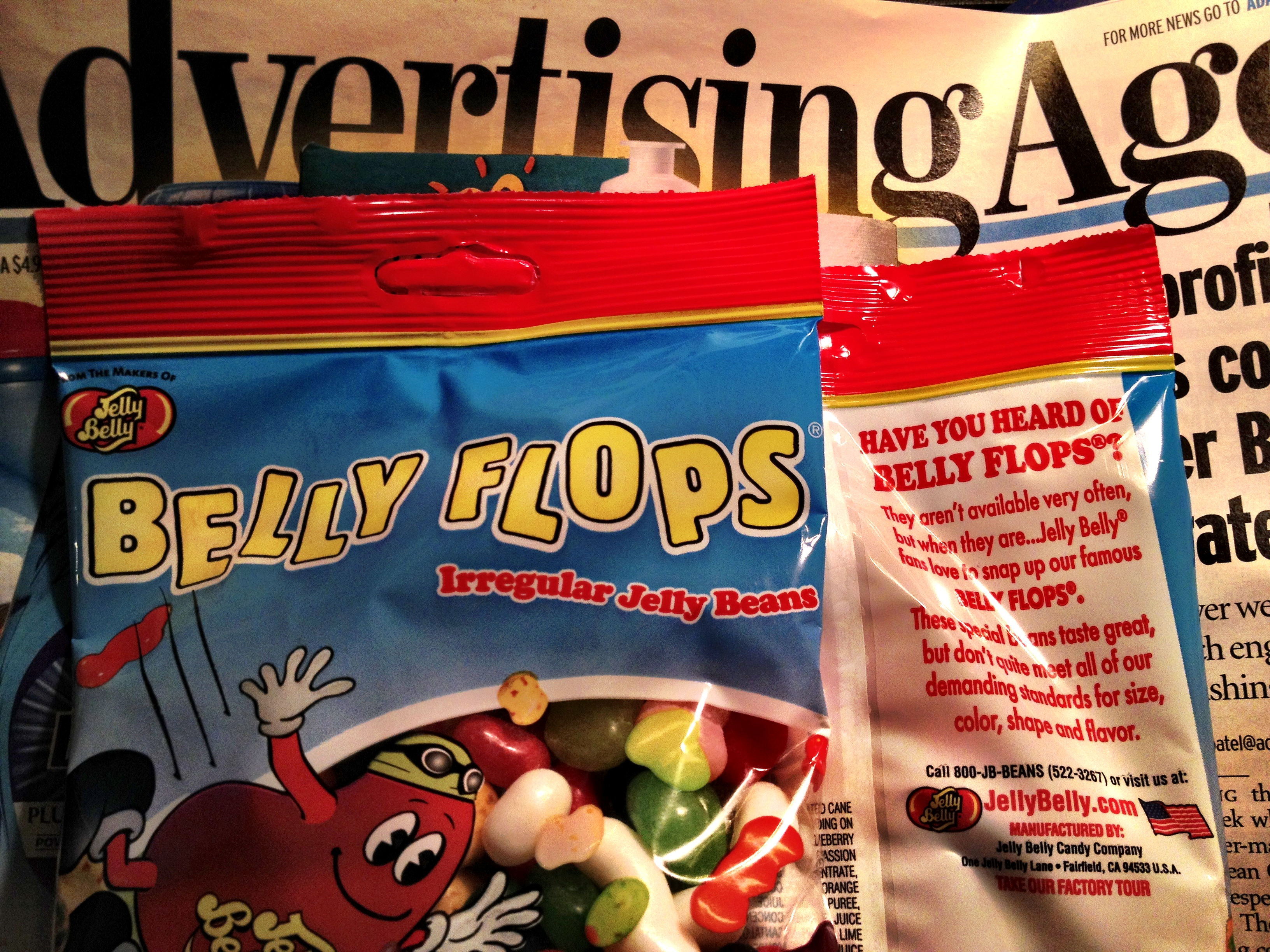
They package ’em and sell ’em, poking a bit of fun at themselves, having a bit of fun with us, all the while staying true to their brand.
These were only a buck a bag at the dollar store. (But only when the company decides to release them, according to the fine print on the package.)
Limited edition Belly Flops. How cool is that!
So, what’s this little story got to do with your business? Glad you asked.
Let’s say you’re an appliance or furniture retailer, just to illustrate with a specific category. The nature of your business is such that display merchandise sometimes sustains minor damage, a nick here, a dent there. Probably there are certain items that have been in your inventory too long and you’d like to put that floor space to more profitable use. So, you have a clearance sale or a “scratch n’ dent event,” right? Well, that’s one way of doing it, and in the process you get to sound like every other retailer that’s ever had a similar sale.
Or, you could set aside a little bit of real estate in a corner of the store and brand it. Round up all those stray “dogs” and put them in this one area. Make it all yours. Give it a name and personality. Decorate it with a dog house and some pet pictures and put up a sign that says: “Dog Pound,” because, after all, your ugly dog could be someone else’s cute puppy. And you use your media advertising and social network channels to promote “Big Dave’s Bad Dogs and Doggone Good Deals” or whatever else you might want to use to call attention to your new clearance center.
Whatever business you’re in, if surplus inventory or distressed merchandise or “factory seconds” are a factor, there’s a good chance you can turn these things into another reason for people to shop your store. Don’t be afraid to take a chance or to poke fun at yourself.
Whenever I meet with a new advertising client or prospect, one of the first items of business is to come to a meeting of the minds concerning the singular importance of:
The Message.
What-the-ad-says has more to do with the success of the campaign than any other factor. Demographics, psychographics, media, reach, frequency, formats, etc. are important, to be sure. But The Message trumps them all.
So, early on we discuss message development. What outcome(s) are we hoping to achieve? What do we want our prospective customer to think, feel, and do? How can we penetrate the prospect’s brain, the seat of thoughts and emotions, and then press all the right buttons to elicit the desired response?
Messages don’t exist in a vacuum. Messages live and breathe in an atmosphere we call context, and there are multiple contexts to be considered. There’s the context that each listener, viewer, or reader brings to the table. There’s the context of community (think: sports, academics, politics, society). There are temporal contexts, spatial contexts, and seasonal contexts. Every advertising medium brings its own context, as well.
When the message meshes with its contexts, communication is facilitated. But if any context isn’t congruent with the message, communication suffers. We’ve all heard radio spots that should have been updated but weren’t. The Christmas gift-giving ad that runs on December 27th. The spot announcing an upcoming Big Sale…that took place last weekend. Or the commercial that opens with, “Summer’s right around the corner…” (an unnecessary introduction under the best of circumstances, it sounds especially lame when it airs in September).
Whose job is it to pay attention to context? Everyone’s, really. That is, everyone who plays a decision-making role at any stage in the process, from concept to completion.
Let me illustrate.
An ad salesman confers with an advertiser about what his ad should say. The salesman, in this example, works for the local newspaper. He brings his notes, maybe even a rough sketch of the ad, to the newspaper’s graphic designer, who in turn womps up the actual ad as it will appear in the paper. They bring a proof copy to the advertiser for review. The advertiser makes corrections (and let’s hope his spelling, punctuation, and grammar are up to snuff, because once he’s signed off on the ad, that’s how it will be printed. If there’s an inappropriate apostrophe, for example, the odds these days are against someone at the newspaper catching and correcting it on their own.) and the approved ad is placed to run in the paper.
Let’s assume they got the ad right. Is that the end of it? Nope. Because that ad doesn’t exist in a vacuum, but in a context. If the layout of the page on which the ad has been placed to run isn’t proofed carefully by a competent editor, this is what can happen:
If you’re investing in advertising or creating advertising for someone, you’ll be well served by remembering that context matters. Pay attention. Follow through accordingly.
I enjoy a funny story as much as anyone. But not every joke is worth telling, certainly not in all places, at all times.
Just because you can tell it doesn’t mean that you should.
Context matters, it really does. Letting fly a formidable beer belch might impress your buddies at the bowling alley, but how would it be received at, say, the library, or in the middle of a church service?
Likewise, the use of certain language that could be described as “colorful” in one context, might be considered crude and crass in another. Same words, different context.
This came to mind recently when an unusual product display caught my eye. It was right there at the checkout counter of a small retail store where I occasionally shop, whose mix of customers includes moms and dads, kids and grandparents, students and teachers, farmers and city folk. There’s no way anybody checking out would miss this display.
Funny to some, but at what cost?
Did it offend me? No. I just smiled and shook my head in disbelief. I did feel a twinge of embarrassment though, for the young lady at the cash register, who obviously was not entirely comfortable with the situation.
Some customers may find this display funny; others not so much. Is the price of a joke or a few pennies of profit on the sale of these items worth risking a customer’s disapproval?
Of course, what I think doesn’t matter; I don’t have a pony in their race.
But if it were my business…?
Well, knowing that the lifetime value of just one good customer is far greater than the value of a single transaction or a fleeting snicker, I think I’d have given it a second thought.
If Roy H. Williams has advertised this elsewhere, I’ve not seen it. But earlier this week, as I was poking around the Wizard’s website, I happened to notice that he’s making available FREE (for how long?) all three of his best-selling advertising and business books, THE WIZARD OF ADS, SECRET FORMULAS OF THE WIZARD OF ADS, and MAGICAL WORLDS OF THE WIZARD OF ADS, in both print and audio versions that can be downloaded right to your computer.
ALL THREE…YOURS FREE!
Over the past decade, few people have made a greater contribution to successful small business advertising than Roy H. Williams, whose New York Times and Wall Street Journal best-selling books have made him a worldwide phenomenon in the advertising community. (“Turning Dreamers into Millionaires” has proved to be no mere slogan!)
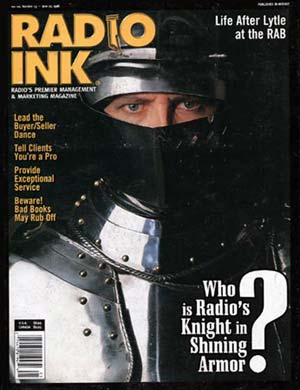
You may have seen this cover of RadioINK back in 1998 or 1999, I don’t recall exactly, but it was when Mr. Williams was offering radio stations a collection of his advertising training videos in exchange for running commercials promoting his new book. Eric Rhoads dubbed the Wizard “Radio’s Knight in Shining Armor,” on account of his unabashed and infectious enthusiasm for the power of local radio advertising and the effect of this on radio advertising salespeople.
I’ve read and reread the books in their original published format and more recently have enjoyed listening to the audio versions on multiple CD’s. I’ve also purchased copies of his books and his DVD, The Most Common Mistakes in Advertising (worth its weight in gold, without qualification) to hand out to clients as well. And most recently, I’ve enjoyed Roy’s monthly “Wizard of Ads Live” webcasts.
If you’ve never read his books, or if you don’t have copies close at hand, this is an opportunity you really should jump on while you can. Roy has made his famous Wizard Trilogy: THE WIZARD OF ADS, SECRET FORMULAS OF THE WIZARD OF ADS, and MAGICAL FORMULAS OF THE WIZARD OF ADS, available FREE in both a print (.pdf) format and an audio (.mp3) format. (A quick search on “Wizard of Ads” at Amazon will show you what these books and audiobooks would set you back if you were to purchase them there.)
My recommendation? Go get them now! Just START reading. The chapters are bite-sized and easy to digest. You’ll probably find it hard to stop at just one.
The .mp3 versions are particularly nice, since they can be burned to CD or copied to your iPod or iPhone, so you can listen while you’re driving between appointments or doing chores on weekends.
3. Use short words, short sentences and short paragraphs.
4. Never use jargon words like reconceptualize, demassification, attitudinally, judgmentally. They are hallmarks of a pretentious ass.
5. Never write more than two pages on any subject.
6. Check your quotations.
7. Never send a letter or a memo on the day you write it. Read it aloud the next morning — and then edit it.
8. If it is something important, get a colleague to improve it.
9. Before you send your letter or your memo, make sure it is crystal clear what you want the recipient to do.
10. If you want ACTION, don’t write. Go and tell the guy what you want.
David
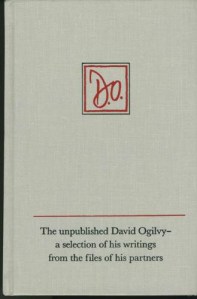
Having recently purchased (at a ridiculous price) a scarce first edition of his unpublished writings, I find myself once more in the company of the colorful Mr. O. Whenever I come to Ogilvy for inspiration, he never fails to teach me something new, and I leave the richer for the time spent with him.
Radio advertisers and radio professionals: linger over number ten. See if it doesn’t smack you between the eyes, as it did me:
If you want ACTION, don’t write. Go and tell the guy what you want.
Tell the guy.
SPEECH, not writing, is still man’s primary form of communication. Print, in all its forms, whether “texting” or “posting” or newspaper advertising or whatever, is still just an approximation, an imitation, of human speech.
Words well chosen, especially when spoken, have a unique power to compel to action.
More than a few radio advertisers know the truth of this.
“I don’t need to advertise. I rely on word-of-mouth. My customers tell their friends.”
How often have you heard those words?
Personal referrals and recommendations are powerful, especially when we’re considering the purchase of a product or service from a new or unfamiliar source.
Successful online retailers from Amazon to Zappos understand the value of customer ratings and recommendations. Ebay created a whole new retail channel, where strangers could buy from strangers with confidence, based on ratings and testimonials of other strangers.
Yes, it sounds funny, but it works. And it all boils down to word-of-mouth.
We prefer buying from people and companies we trust. And trust is developed over time, on the basis of familiarity and experience.
For those of us in radio advertising, “word of mouth” has a special significance. It is, after all, how we earn our living. The primary tool of our trade—indeed, mankind’s primary means of communication—is human speech.
Now, all of this serves as a rather lengthy introduction to the real topic under consideration: the power of real people stories in advertising and marketing.
Perhaps you’ve created commercials built around customer testimonials. Hopefully, they worked well for you. Unfortunately, even the most well-meaning customer, reading from a script, can be reduced to ridiculous in seconds. Even worse is the spot that purports to feature a “satisfied customer,” played by a staff announcer or an office assistant coaxed into the production studio to voice the role. (Incidentally, fraudulent testimonials, no matter how innocuous or well-intentioned, violate the Federal Trade Commission’s Truth-in-Advertising laws. Google it.)
A valued mentor, Roy H. Williams*, likens testimonials to nitroglycerine. Done well, they’ll produce explosive results. Done poorly, they’ll blow up in your face.
Let me illustrate. Meredith was a patient of Dr. David Leach at Clearview Eye Clinic in Moscow, Idaho. They’d asked Meredith to write up her story and read it in her own voice. Here’s that spot as recorded and mixed by a busy production person at a local radio station, prior to my involvement.
Fortunately, the client realized that even though Meredith’s story is true, the message sounded contrived or forced. They asked me if I could come up with a better presentation.
So, I arranged to interview Meredith. We had a casual, comfortable conversation over coffee. In the space of 30 minutes, she shared her story. Later, I interviewed both Dr. Leach and his nurse, Rhonda, to get their side of Meredith’s story. Then, armed with nearly an hour’s worth of audio, I began editing the audio files, weaving together the three stories into one. Here’s how it turned out:
Hear the difference? Of course, you do. It’s the same set of facts in both spots but while one just talks at you, the other grabs you and pulls you into the story. It’s authentic, believable, engaging…and effective!
Word-of-mouth is powerful. And radio, the only pure audio medium, is uniquely suited to sharing your story with new prospects and future customers.
*I shared a couple of these spots with Roy. His comments made my day.


 I was hired recently to write and produce a radio spot encouraging folks wanting to send flowers to do business with a local florist in the recipient’s neighborhood, rather than going through one of the “1-800” number services.

 Or, you could set aside a little bit of real estate in a corner of the store and



 RodSpots: the Next Chapter