Ed Van Nuland on Procrastination

Eddie Van Nuland

Eddie Van Nuland

My buddy Ed Van Nuland never fails to impress with his witty one-offs.

A favorite of mine is the term he invented to describe the state of being temporarily short of funds:

Coinus Interruptus.

This morning, out of the blue, he mentioned being preoccupied with the idea of procrastination.

He observed:

Procrastination is both an art and a science.

The science is determining the exact moment you must stop procrastinating.

The art is being able to push it beyond that point.

Undoubtedly this will appear one day in auspicious collections of aphorisms and quotations. When it does, let the record show that its author is one Edward Van Nuland.

Posted in Advertising (General), Communication, Copy, Life lessons, Procrastination, Uncategorized | Tagged , , , , | 2 Comments

Dazzling Them With Brilliance in Moscow, ID

Driving Motorists to Distraction?

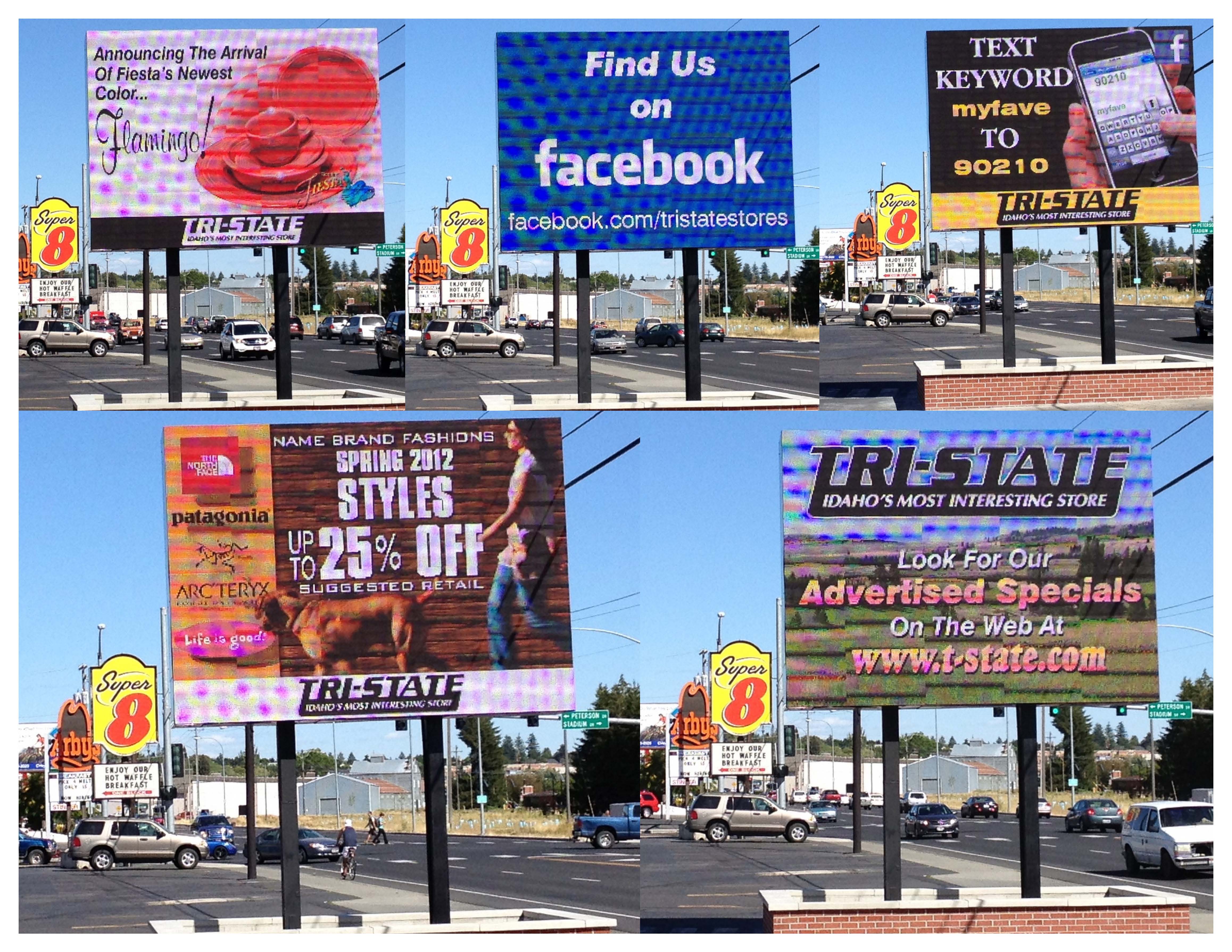
You can’t drive by this thing without noticing it.  And that, of course, was the whole idea: make it BIG, COLORFUL, and IN YOUR FACE!!  The first time I saw it, I thought, “WOW! Brilliant marketing, Tri-State!!”

Each side of this jumbo Janus measures 192 square feet, a ton of marketing real estate, anchored alongside a major arterial.  Thousands, possibly tens of thousands of motorists drive past this towering teaser every day.  And the advertising messages that flash and pop on its gigantic screen have something extra going for them, something that is missing when similar messages appear on the printed page of a newspaper or magazine: they’re intrusive!

Intrusiveness in advertising is important. It gives the message a fighting chance to jump out of its context, breach the eye gate or the ear gate, and lodge itself in the brain of the consumer.

One of the factors affecting the potency of outdoor signage is location.  In the market where I live most billboards are set back so far from the roadway, lack of proximity alone makes them ineffectual.  Couple these poor locations with the tendency of too many advertisers to cram too much information onto that small canvas, and you’ve added insult to injury.  Next time, just burn the money in your fireplace and at least you’ll get something out of it.

But these animated LED displays are a whole other thing, situated right along the sidewalk at the perfect height above motorists to catch their attention.  And unlike billboards, whose messages can’t easily be changed, these computer-controlled electronic signs can display an endless variety of messages, a new one every few seconds, in dazzling color, brilliant high-def graphics and eye-popping text…mesmerizing, indeed.

And therein lies the problem, according to some motorists and others who’ve complained to their elected officials that such signs pose an imminent hazard to other motorists and to pedestrians trying to cross the street, for example, and finding themselves forced to compete with the big sign for the attention of drivers, distracted by the deal of the day.

Now, in view of recent legislation making texting-while-driving illegal (in addition to being intrinsically stupid) throwing up a sign exhorting viewers to “text keyword myfave to 90210” wasn’t the smartest move on Tri-State’s part.  But that’s a messaging issue.

Still, as a marketer and advertising professional, I like these signs.  They have unique potential to drive business into the store, assuming the store knows how to get the message right.  (Sadly, I also see businesses with programmable signs that squander their potential, settling for insipid and ineffective messages.)

Something else makes these signs attractive to me.  They give the advertiser an opportunity to own his own advertising medium, and not just rent it.

As I write this, the Moscow, ID City Council has recently enacted an emergency ordinance governing new signs, providing a window of 182 days for them to study the effects of the ones already in place.  As they debate the issues of free speech and free markets over against the public welfare, it remains to be seen how many other businesses will be able to follow Tri-State’s lead.  Tri-State erected its sign within the framework of existing codes and will likely enjoy the protection of being grandfathered, regardless of the outcome of the council’s discussions.  If limitations are placed on future sign installations, competitors may argue that city government has given an unfair competitive advantage to one business over another.

Stay tuned.

Posted in Advertising (General), Business, Communication, Copy, Graphic design, Information overload, Magazine, Newspaper, Positioning, Print, Promotions, Proofreading, Radio Advertising, Sales, Sales & Marketing, Shop Local, Slogans and taglines, Uncategorized | Tagged , , , , , , , , , , , , , , | Leave a comment

The Man with One Leg (Guest Blog)

Marcus Sheridan, an inbound marketing specialist and consultant, blogs at his website, The Sales Lion.  My daughter Rebecca subscribes to his feeds (as do I now) and passed this post along to me in an email. I was impressed with Marcus’ observations and even more so with his conclusions, which I am pleased to share with you, too.  -RS
 

The Man with One Leg

by Marcus Sheridan

As I’ve flown around the country these past few weeks, Life has been kind enough to teach me at almost every corner.

Note from Marcus*** This post is not about marketing, it’s about life. Now you know.

The Man with One Leg

As I stood in the Charlotte Airport last week waiting for my flight, I noticed a stocky, burly man with a shining countenance and smile. Based on his athletic stature and crew-cut hair, I surmised he was ex-military. Apparently, the war had left a mark on this man, as he was missing an entire leg and crutches were now used in its stead.

Shortly after, an attendant approached him and asked if he’d like to go ahead and board the small plane (with its steep steps) that was waiting for us on the runway.

Curious to see how the gentleman would handle getting in the plane, I stood at the window and eagerly watched his approach. With the same smile continuing on his face, he slowly took the first step onto the ladder.

As the captain stood on top of the steps and a stewardess stood beneath him in case he couldn’t make it, I was mesmerized as the man slowly hopped up the steps, looking gratefully at the captain above and seemingly unfazed by the fact that so many eyes, mine included, were watching his every move.

Moments later, the man had entered the plane, but his positive attitude had left me impressed, grateful, and incredibly inspired.

First Impressions

On another flight coming home from Texas two weeks ago, I was seated behind two young siblings, one a boy about 7 and the other a girl about 9 years old. Within minutes of watching these two, I could see it was going to be a long flight. They were fighting, arguing, slamming the arm-rest that was between them up and down, and doing just about anything they could to cause a commotion.

Even worse, with each new disturbance the mother surprisingly said very little, and simply put her finger over her lips as to say “Shhh” to the children, only to go back to reading the book she was holding.

Being a dad myself of 4 relatively calm kids, my thoughts wondered as to how anyone could let their children act the way they were acting.

After two hours of watching these two go at each other with the mother saying so little, the plane finally landed.

As we were disembarking, a man sitting next to me asked the young boy if he was glad to have landed. His response was telling:

“Yes. This is our second flight today. On the first flight, my mommy was crying because we left Daddy in Georgia.”

As the boy said this, I looked at his mother flinch a little across the aisle. It was also in that moment I saw she was reading a book entitled, “Understanding your spouse.”

Suddenly, the previous two hours began to make so much more sense to me.

The two children had just said goodbye to their father.

The mother had left her spouse.

Tough times indeed.

It was in this moment my entire perspective changed. Instead of feeling frustration I felt compassion and my heart broke for these two kids that obviously had no idea how to deal with what they were going through.

Timeless Love

As I boarded a plane heading to Arkansas two weeks ago, I noticed a man in his 70s with his aged wife leaned up against him. Her eyes were closed and her head buried against his neck, but what was so striking was this dear lady was shaking uncontrollably. Yes, Father Time had taken his toll and now she was essentially helpless, unable to control her movements, leading to a trembling that wouldn’t cease.

What touched me though was this man’s stoic nature. His face was stern yet loving, with something about it that seemed incredibly protective of his dear wife of what I’m sure was decades of companionship.

In short, he represented everything a friend and spouse should be, and I was moved by his example.

A Small Hand

As I hopped on a plane headed to Boston last week and saw what row I was sitting in, I could see a mother sitting in the first seat and in the middle was a little girl, 2 or 3 I’m guessing, buckled into a car seat. As I looked at the mother, I could sense her nervousness—likely worried as to who would be sitting next to her daughter and what the reaction would be.

Once I sat down, I could see why she was worried. The small child was handicapped and struggled to perform many of the functions the rest of us take for granted. Her eyes seemed to wonder, her arms would occasionally flail, and she appeared to be mute as well.

But amid all of this, she was a beautiful little girl with a magical smile. And when I would look at her and grin, she would return the favor.

After a while, she started grabbing my arm so as to hold it. Her mother would quickly ask her to stop and at first I acted like I didn’t notice.

About the 4th time the little girl grabbed my arm with her small hand and the mother began to ask her to stop, I gave her a simple look of assurance and told her everything was OK, and that as a father of four little ones myself, it was nice to have someone the same age of my youngest, sitting next to me.

The mother seemed relieved and for the rest of the 90 minute flight, I felt a little hand across my forearm.

Once again, gratitude filled my heart as thoughts and reflections on my own life, health, and children flooded my mind.

Life

Life is an interesting adventure my friends. And if our eyes and minds are open, there are lessons to be had at every corner.

Such has certainly been the case for me over these last 3 weeks as I’ve flown around the country to do something I love—teach.

But in the midst of me attempting to be the teacher, I’m amazed at the ways in which life has found precious moments to instead make me the student.

To say I’m grateful would be an understatement…

Have a wonderful Monday everyone, and thanks so very much for all your support.

Posted in Communication, Consultants | Tagged , , , , , | Leave a comment

“How to Write Good” – Help for Ad Writers from Federal Employees

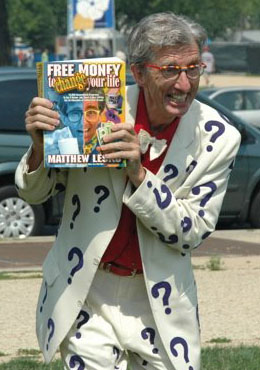
Remember him? He wrote the book on getting free help and money from the federal government.

Many resources are available to assist aspiring ad writers, but who’d have thunk that Employees of the Federal Government of the United States would be among them?

Meet PLAIN, the Plain Language and Information Network, a group founded in the 1990s, whose lofty goal is no less than “…to promote the use of plain language for all government communications. We believe that using plain language will save federal agencies time and money and provide better service to the American public.”

Imagine: federal employees meeting monthly, on their own time and dime, to identify ways to improve communication between federal agencies and We the People.

Put me down for a big “Like.”

According to the group’s About Us page:

To promote plain language, we

  • offer limited editing services to all federal agencies
  • sponsor occasional seminars about plain language
  • comment on agency documents, especially regulations
  • offer a short half day introduction to plain language and writing for the web free of charge to any federal agency

To illustrate the advantages of plain language over government-speak, PLAIN provides a number of before-and-after illustrations.  For example:

Before
When the process of freeing a vehicle that has been stuck results in ruts or holes, the operator will fill the rut or hole created by such activity before removing the vehicle from the immediate area.

After

If you make a hole while freeing a stuck vehicle, you must fill the hole before you drive away.

Has the Internal Revenue Service been made aware of this resource?

It appears that President Obama discovered PLAIN’s work and decided to make it an important part of his administration and legacy. Two years ago, he signed The Plain Writing Act of 2010, requiring that federal agencies use “clear Government communication that the public can understand and use.”  On January 18, 2011, he issued a new Executive Order, “E.O. 13563 – Improving Regulation and Regulatory Review.” It states that “[our regulatory system] must ensure that regulations are accessible, consistent, written in plain language, and easy to understand.”

Our government has not yet declared war on ad-speak, however.  I know this because:

1. Ad-speak is still ubiquitous in America. Cliché-ridden drivel permeates advertising in all media, and is no respecter of markets or budgets.

2. The government itself has mandated an entire category of ad-speak, otherwise known as “legal disclaimers.”  In print these disclaimers are usually buried at the bottom of an advertisement in type so small a magnifying glass is required to read them. Likewise, in TV commercials these disclaimers can be superimposed on the screen in a text format that is unreadable by most normal people. But in radio, alas, these disclaimers must be spoken, resulting in digitally compressed speed-read gibberish at the end of the spot. (Next time you hear one and shake your head in disbelief, remember: it’s your tax dollars at work.)

3. Worse, the government insists on foisting ad-speak on its citizenry.  Consider its recent mandate to protect undiscerning consumers of broadcast advertising from predatory politicians who might try to slip something past us when we’re not paying attention, by requiring them to proclaim: “I’m so-and-so and I approve this message.”  Ugh.

Fortunately, PLAIN has not hidden its efforts under a bushel, limiting access to its resources only to government agencies and employees.  Ad writers and producers working in the private sector have equal access to the gems reposited in their online treasury, such as this masterpiece by advertising copywriter Frank L. Visco, which first appeared in the June 1986 issue of Writer’s Digest: “How to Write Good.” 

HOW TO WRITE GOOD

by Frank L. Visco

My several years in the word game have learnt me several rules:

  1. Avoid alliteration. Always.
  2. Prepositions are not words to end sentences with.
  3. Avoid cliches like the plague. (They’re old hat.)
  4. Employ the vernacular.
  5. Eschew ampersands & abbreviations, etc.
  6. Parenthetical remarks (however relevant) are unnecessary.
  7. It is wrong to ever split an infinitive.
  8. Contractions aren’t necessary.
  9. Foreign words and phrases are not apropos.
  10. One should never generalize.
  11. Eliminate quotations. As Ralph Waldo Emerson once said: “I hate quotations. Tell me what you know.”
  12. Comparisons are as bad as cliches.
  13. Don’t be redundant; don’t use more words than necessary; it’s highly superfluous.
  14. Profanity sucks.
  15. Be more or less specific.
  16. Understatement is always best.
  17. Exaggeration is a billion times worse than understatement.
  18. One-word sentences? Eliminate.
  19. Analogies in writing are like feathers on a snake.
  20. The passive voice is to be avoided.
  21. Go around the barn at high noon to avoid colloquialisms.
  22. Even if a mixed metaphor sings, it should be derailed.
  23. Who needs rhetorical questions?

A second set of rules, attributed to William Safire, follows Visco’s original twenty-three:

  1. Parenthetical words however must be enclosed in commas.
  2. It behooves you to avoid archaic expressions.
  3. Avoid archaeic spellings too.
  4. Don’t repeat yourself, or say again what you have said before.
  5. Don’t use commas, that, are not, necessary.
  6. Do not use hyperbole; not one in a million can do it effectively.
  7. Never use a big word when a diminutive alternative would suffice.
  8. Subject and verb always has to agree.
  9. Placing a comma between subject and predicate, is not correct.
  10. Use youre spell chekker to avoid mispeling and to catch typograhpical errers.
  11. Don’t repeat yourself, or say again what you have said before.
  12. Use the apostrophe in it’s proper place and omit it when its not needed.
  13. Don’t never use no double negatives.
  14. Poofread carefully to see if you any words out.
  15. Hopefully, you will use words correctly, irregardless of how others use them.
  16. Eschew obfuscation.
  17. No sentence fragments.
  18. Don’t indulge in sesquipedalian lexicological constructions.
  19. A writer must not shift your point of view.
  20. Don’t overuse exclamation marks!!
  21. Place pronouns as close as possible, especially in long sentences, as of 10 or more words, to their antecedents.
  22. Writing carefully, dangling participles must be avoided.
  23. If any word is improper at the end of a sentence, a linking verb is.
  24. Avoid trendy locutions that sound flaky.
  25. Everyone should be careful to use a singular pronoun with singular nouns in their writing.
  26. Always pick on the correct idiom.
  27. The adverb always follows the verb.
  28. Take the bull by the hand and avoid mixing metaphors.
  29. If you reread your work, you can find on rereading a great deal of repetition can be by rereading and editing.
  30. And always be sure to finish what

In short, PLAIN has provided a wealth of resources for anyone wanting to communicate more effectively, and they’ve done it out of the goodness of their collective hearts.

Bless ’em all.

Posted in Advertising (General), Business, Communication, Copy, Copywriting, Newspaper, Print, Productivity, Professional Services Advertising, Proofreading, Radio Advertising, Radio Commercials, Radio Copywriting, Radio Production, Storytelling, Uncategorized | Tagged , , , , , , , , , , , , , , , , , , , , | Leave a comment

I’d Like to “Buy Local” But… (Guest Blog)

Thanks to my generous and talented friend Blaine Parker for letting me share his insights with you.  This article originally appeared in his “relentless weekly screed,” otherwise known as Hot Points.  Get your free subscription here.

As many of my radio station clients know, our company produces a series of syndicated
“Shop Local” radio features designed to help the station, the local Chamber of Commerce, and local businesses spearhead a Shop Local initiative in their market.  Few have ever raised an objection in principle to the notion that shopping locally accrues to the benefit of those who live in that community.  But what happens when a local business makes it difficult for a consumer to want to spend money with them?  No amount of advertising can fix a business problem like this.  Blaine’s article, based on a recent personal experience, helps to frame the dilemma and provides food for thought – both for business owners and the media that serve them.

IF YOU WANT ME TO BUY LOCAL, PROVE IT

The whole “buy local” philosophy seems,  on the face of it, an honorable proposition.

It doesn’t take too long to dig just below the surface and realize it’s a problematic philosophy.

Case in point: in my local shopping district, there are two virtually identical businesses within one block of each other.

One is a national chain. The employees are always energetic, smiling, ready to serve, happy to engage.

The other is a local joint. The employees are always moving at their own speed, they might be smiling, they’ll get around to serving you, and they’re more interested in engaging with that cute guy sitting at the counter.

The product from the national chain is pretty good and always consistent in its quality.

The product from the local joint is often not so good and is not consistent in its quality.

WHICH BUSINESS WOULD YOU RATHER PATRONIZE?

The crime of it is, we’d really rather go to the local shop.

It just isn’t very good.

They’re trying, sort of.

The guys who own the place seem to think they’re doing a good job.

Unfortunately, they’re in denial.

My wife went in one day, and one of the owners happened to be behind the counter. Seems he was very enthusiastic about a brand new menu item. He talked her into trying it.

Later on, he asked her how it was.

She was candid: it wasn’t very good. It tasted as if it had been sitting around and was reheated.

Of course, he did what any conscientious small business owner would do: he told her she was wrong.

HOW DO THESE GUYS STAY IN BUSINESS?

I suspect it’s like a lot of businesses: they are just competent enough to stay afloat.

And they will have their fans.

Because, frankly, there is no accounting for taste.

But there is no doubt that these local guys will never be franchising or becoming a chain. They’re incapable.

They have a wobbly cart that would never go the distance.

And it’s almost a lock that this guy probably doesn’t pay his employees very well.

That’s why he doesn’t have consistent quality in his service or his product: his people probably aren’t paid enough to care.

Contrast that with the national chain, where the employees are paid well and actually have benefits.

The national chain is notable for its crackerjack management and its company culture.

Which leads to an interesting premise, one that I don’t know that I ever would have considered so importantly linked to brand.

SHOW THEM THE MONEY

There’s an interesting new book by a fellow named Mark Gardiner.

Available only on Kindle, it’s called Build a Brand Like Trader Joe’s.

Mr. Gardiner is a former ad agency creative director who decided to take a job at Trader Joe’s.

While he doesn’t say as much, it sounds like he’s semi-retired.

He left the ad biz to race motorcycles and has written several books. And when Trader Joe’s opened a store in his town, he decided to sign on. He wanted to enter on the ground floor of one of the coolest brands around and see where it took him.

Without giving too much away, Mr. Gardiner talks about how Trader Joe’s gets a lot of their business wrong.

Part of the reason for their raging success is their people.

If you’ve never been to a Trader Joe’s, if you’re one of the unfortunates who lives in a non-TJ market, know that the experience (ah, there’s that ever-important word again) is fueled by a team of people who have truly drunk the Kool-Aid.

You are never going to meet a more enthusiastic supermarket employee than you’ll meet at Trader Joe’s. They strike up conversations about your purchases, they go way above and beyond to help you in the store, they make suggestions–they live, breathe, sleep and (of course) eat Trader Joe’s.

Part of the secret to their success, as far as Mr. Gardiner is concerned, is that they offer good compensation and opportunity for advancement.

GOOD COMPENSATION IS PART OF A BRAND?

Indeed it is.

Yes, you still need to have a brand direction. You need to know what that one thing is you want people to feel about your business.

You have a brand mission, as it were.

And once you’ve defined the mission, you need people who can carry it out.

Good people.

And good people are hard to come by if you’re a cheapskate.

What’s one of the things that companies start to do when the economy gets shaky?

Some bean counter is tasked with finding fat in the budget.

And since the intangible value of experience and enthusiasm isn’t a measurable line item, the bean counter points to some of the most profitable employees and says, “These people are getting paid too much.”

And someone at the top, probably a bean counter who’s been promoted to a position of vice-presidential authority says, “Off with their heads!”

And the budget is brought “under control” as the brand begins to crumble, its worth to the customer disintegrates, and the brand is eventually a mere shell of its former mighty self.

I’ve seen it happen.

MISERS, CHEAPSKATES AND SKINFLINTS DO NOT MAKE  FOR GOOD BRAND

Don’t get me wrong. I’m all for fiscal prudence. I am, after all,  a New Englander of Scottish ancestry. Color me thrifty.

But good people cost money. And you can’t build the brand without them.

We have a client in the Philippines. (Yes, he’s outsourcing his branding to the US. Anyone want to complain that he’s not buying local?)

And one of the first things that this gentlemen was adamant about was that he has good employees and he treats them really well.

Despite the fact that we’re just beginning to craft his brand, he already has brand integrity.

He wants to do good work for good clients, and he pays his people well. His brand is going to be rock solid.

I’ve seen businesses that were run by true skinflints, and everything about their cheapness is reflected in the brand.

I’ve seen customers patronize these businesses as a necessary evil.

And I’ve seen those customers deride those brands mercilessly behind the owner’s back.

Buying local is a good idea.

But deserving my business is an even better idea. Pay your people like they matter. Because they do. They’re the ones who deliver your brand to me. If they fail, so does your brand.

Posted in Advertising (General), Branding, Business, Client-voiced commercials, Communication, Copy, Copywriting, Grace Broadcast Sales, Positioning, Problem-solving, Radio Advertising, Radio Commercials, Radio Production, Sales, Sales & Marketing, Shop Local, Storytelling, Uncategorized | Tagged , , , , , , , , , | Leave a comment

Sometimes the Client Wins the Award

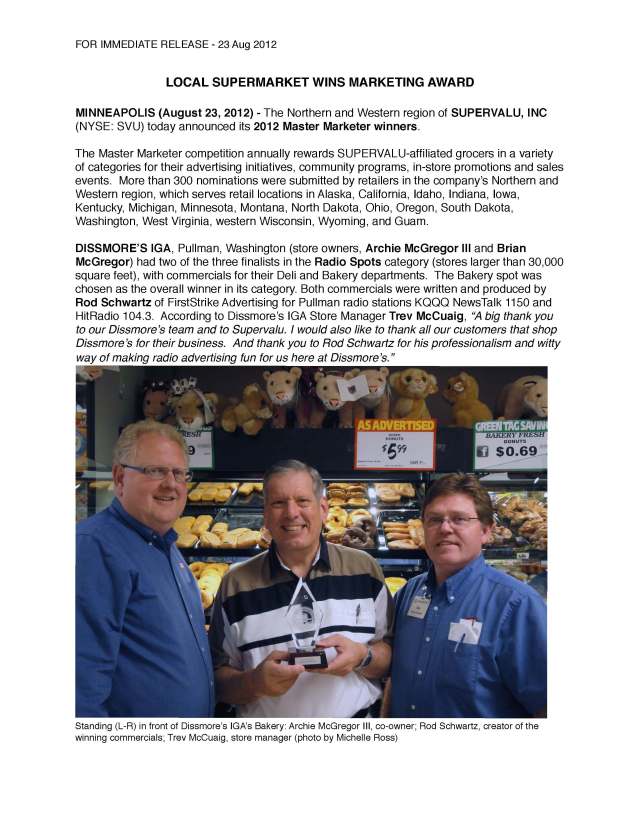
On the same day the Radio Mercury Finalists were announced (my lone entry not having made the final cut), I received word that one of my favorite clients, a local supermarket, had won top honors in a recent marketing competition involving more than 300 SUPERVALU stores, for a radio spot I’d created for them.

That made me feel pretty good.

In fact, I later learned that two of the three finalists in the Radio Spot category had been my spots. Even better.

Awards are nice perks.

The recognition, whether from the radio advertising community or the supermarket industry, provides a fleeting bit of peer validation of one’s work.  (Think smiling Sally Field in 1984: “You really like me.”)

The majority of radio commercials never win awards.  Most are never even entered into competition.  It’s almost axiomatic in our business: commercials that win awards often fail in the marketplace, whereas commercials that increase sales rarely win awards.  The rare exceptions are special, indeed.

What matters most, to most advertisers, is whether the investment in radio advertising results in a profitable return.  All indications are that these two commercials have helped attract business to their respective departments.

The award?  Frosting on the cake.

Posted in Advertising (General), Awards, Branding, Business, Copy, Copywriting, Radio Advertising, Radio Commercials, Radio Copywriting, Sales, Sales & Marketing, Uncategorized | Tagged , , , , , , , , , , , , , | Leave a comment

Some Mighty Fine Radio Work!

This year’s Radio Mercury Awards competition include some real gems produced by radio station creatives.
Among my favorites, these spots for garage door specialist Buy Doors Direct:

A catchy tune, real humor that stays anchored to the sales message, an engaging presentation of benefits,  clear call-to-action and a single point of contact – well done, Clear Channel!

Visiting my hometown of Chicago last September for the first time in many years (thanks to the NAB/RAB Radio Show), I couldn’t get used to the all the NOISE everywhere in the downtown area, incessant, pervasive…no wonder people there seem so restless.  It gave me renewed appreciation for living in this garden spot called the Palouse, a kind of place people in Chicago might pay big bucks to get away to.   This spot, created by Tribune broadcasting, does an effective job of selling noise-weary Windy City denizens a destination for relaxation relatively close to home:

Speaking of closer to home, the KXLY Broadcast Group up in Spokane created this gem for Kokanee Beer:

For Seattle residents wondering where Spring went, Bonneville Radio answers the question in this fine spot for the Yakima Visitor’s Bureau:

To hear more great radio work, visit the Radio Mercury Awards website.

__________

P.S.  Yes, I did enter one of my spots into this year’s competition.  No, it didn’t make the final cut.  Yes, I’m a little disappointed.  No, I’m not really surprised.  Yes, you can listen to it here.  Thanks for asking.

Posted in Advertising (General), Awards, Branding, Communication, Copy, Copywriting, Radio Advertising, Radio Commercials, Radio Copywriting, Radio Production, Storytelling, Voice Acting | Tagged , , , , , | Leave a comment

The Best Steak Marinade Ever

Today I blog about branding, beef, and bull.

A great steak needs nothing but a bit of salt and pepper.

Having grown up in Chicago, I know the taste and buttery texture of a great corn-fed beef steak.  We never marinated them.  Never had to.

Now I live in eastern Washington State, an area renowned for its wheat, barley, peas and lentils.  A short drive to the west leads to our state’s iconic apples and other tree fruit.  And grapes.  Washington’s wines are increasingly world-class.

But not its beef.

In fact, the few ranchers here that raise beef pride themselves on their healthy, grass-fed beef cattle.  Healthy.  Lean.

And toothsome.

I bought half a grass-fed beef once.  The hamburger was great.  The steaks, not so much.

Safeway used to carry USDA Choice Beef, years ago.  It was possible back then, every so often, to find a package of unusually well-marbled ribeyes.  Not prime, mind you, but not bad. Whenever I visited the store, even if only for a gallon of milk, I’d always detour to the meat counter in the hope of finding fat-flecked treasure.

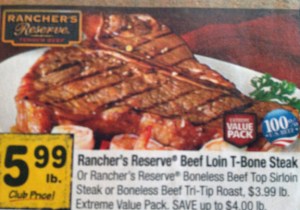
Then, in a masterful bit of supermarket sleight-of-hand, Safeway introduced their customers to “Rancher’s Reserve®.”  What image does that name, Rancher’s Reserve®, conjure up in your mind?  Beef ranchers holding back their best for Safeway and its customers?

Well, that’s what Safeway hoped you’d infer from the fancy new name.  You were supposed to think:  Rancher’s Reserve® = best USDA Choice beef reserved for Safeway customers.

After all, isn’t that what branding is all about? Whether it’s cattlemen branding their livestock to distinguish one herd from another, or marketers creating fancy names to differentiate their products, the goal is to create associations between a product or company and what it stands for in the mind of the customer.

In the mind of this customer, it eventually stood for “bull.”  Better still: weasel.

Now, when Rancher’s Reserve® was launched, Safeway was still selling its customers USDA Choice beef.  This cost them more, of course, but it also meant higher quality, more marbling, more tender and flavorful beefsteaks.  But some months after launching the Rancher’s Reserve® program, Safeway downgraded the quality of their retail beef offerings from USDA Choice to Select, which they could buy at a lower cost.  So, Rancher’s Reserve® ended up being “run-of-the-ranch.” USDA Select.  Plain, ordinary, chewy beefsteak, just cut a little thicker.

But I digress.

A few months ago I had the pleasure of participating in an Eggfest, a gathering of fans of the Big Green Egg, held in the parking lot of their local dealer (a client of mine).  I grilled Alaskan sockeye salmon.  Nearby Bob Smith, a fellow Egghead, was grilling tri-tip beef steaks, the best I’d ever tasted.  The secret, it turned out, was his marinade, the recipe for which he was happy to share with me.

A week or so after the Eggfest, I pulled some beef tenderloin steaks out of the freezer and decided to see what kind of magic Bob’s marinade might work on them.  We were not disappointed.  The steaks were not only tender but surprisingly full of flavor, too.

This past weekend I decided to try Bob’s magic marinade on a big ol’ (USDA Choice) T-bone steak from Costco.  Whipped up a half-batch, poured it into a Zip-loc bag, and let the steak marinate in it for 5 or 6 hours before grilling it.  Three of us enjoyed it for dinner (did I mention it was a big steak?) and were all in agreement that it was, in a word, superb.  Unlike any other marinade I’ve ever tried, this one didn’t change the flavor of the beef; it enhanced the flavor, made it more…steak-y.  Honestly, verbal descriptions don’t cut it.  This is one recipe you just have to try for yourself.

I emailed Bob today and obtained his permission to share this wonderful marinade recipe with my friends.  Enjoy!

BOB SMITH’S MAGIC MARINADE FOR BEEF STEAKS (Proportions are approximate.)

  • 1 cup soy sauce
  • 1/8 cup Worcestershire sauce
  • Several cloves of garlic, chopped
  • Bunch fresh rosemary and thyme, chopped
  • 2 tbs. toasted sesame oil
  • 1 shot of Jack Daniel’s or other whiskey (great meat tenderizer)
  • A little bit of vinegar if you don’t want whiskey
  • A little more oil

Pour over meat in a zip lock bag.  Turn the bag every now and then.  We marinated the steaks for 5 hours or so but even an hour will add a nice flavor.  (You might pierce the steaks several times with a fork to allow marinade to penetrate if you’re shortening the marinating time. – RS)

Let me know how you like it!

Posted in Branding, Uncategorized | Tagged , , , , , , , , | 1 Comment

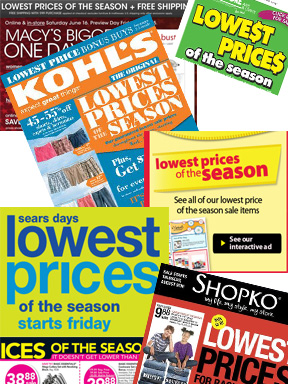
Advertising Slogans We’d Love to See – Any Mass Retailer

They keep saying it because people keep believing it.

Lowest Prices of the Season*

*and by that we mean “until the next time we say ‘Lowest Prices of the Season.'”

Ever ask yourself what all these stores mean when they advertise “lowest prices of the season” or “biggest sale of the season?”

What constitutes a “season” in retail ad-speak?  And are all these different stores, competitors in many cases, in agreement as to when the “season” begins and ends?

Let’s call it what it is: a weasel word.  A term of equivocation, used in place of a proposition that can be easily measured and tested.  Weasel words help their users avoid having to make a direct and meaningful commitment.  The origin of the term stems from a weasel’s habit of sucking the egg out of a shell without breaking the shell to pieces, thereby leaving the casual observer with the impression that the egg is intact.

Examples of weasel words abound in the literature of advertising.  Many years ago, when “like” was used as a comparative and not merely as a place holder, a substitute for “uhhh,” it became a popular weasel: wear this lipstick or perfume and you’ll feel like a supermodel. Buy this mattress and you’ll sleep like a baby.  Or the granddaddy of them all, “Winston Tastes Good Like a Cigarette Should.”

Helps.  Up to/as much as. Performance. Virtually. Service. Quality.  Different.  Special.

Weasels, all.

Why do advertisers insist on using weasels instead of making specific, propositional, verifiable statements?

Because consumers continue to fall for them.   They may not actually be the lowest prices available on a given item–at another store, or online, or at another time in our store–but by golly, they’re the lowest prices of the season today at this store, so we’d better hurry in and buy now, before it’s too late.

We believe, “there’s never been a better time to buy.”

We believe, “never before and never again.”

And of course, when they’re gone, they’re gone, right?

Right.

Posted in Advertising (General), Business, Communication, Copy, Newspaper, Slogans and taglines | Tagged , , , , , , , , , , , , , | Leave a comment

Finding and Keeping a Great Salesman

Selling? Writing? Or both?

In a March 2012 blog post, Seth Godin noted the difference between the perception and the reality among professionals regarding their allocation of time in operating their business.  He used professional photographers to illustrate his point that managing time and resources involves trade-offs, but it certainly extends to entrepreneurs and leaders in any field.

The Internet has made it possible for an individual to learn new skills and to try his hand at many tasks that otherwise might be delegated or outsourced.

But merely having the opportunity doesn’t make pursuing it the highest and best use of one’s time.

Take radio advertising salespeople who are tasked with writing their advertisers’ copy, common in small and medium markets, and not uncommon in larger markets. Some salespeople are also competent ad writers; they’ve studied the art of advertising, read the masters, taken copywriting courses, etc.  They’re able to write effective ad copy and do so regularly.

But at what cost?  Is there a trade-off?

Seth Godin asks: are you doing the work you were born to do?

Time spent writing (often preceded by time spent in research) is time not invested in prospecting, presenting, and ultimately selling new advertising accounts.  Selling is what pays the bills.

Copywriting, certainly an essential part of the service we offer to our advertisers, may be a means to that end.  If writing commercials is part of what fuels the salesperson’s passion and effectiveness, then the additional investment of time and effort may well be justified.

But if a salesperson’s time is more productively spent doing sales work other than writing ad copy, it’s incumbent upon management to provide a copywriter who can do the job at least as well, and hopefully better than the salesperson.

We might take a cue from our brethren at the newspaper.  Newspaper ad reps typically do not design their own ads.  They gather information from their advertisers and pass it along to full-time graphic designers, typesetters, or advertising compositors, who are tasked with the actual creation of their clients’ newspaper ads.  Been this way for a long, long time.

Yes, it will cost some bucks to find and keep one or more good copywriters on staff.  But what’s the true (if hidden) cost of having your salespeople do it?

And speaking of hidden costs, this last paragraph caught my eye:

One thing to consider: finding and retaining a great salesperson is more difficult than you might think, since a great salesperson might very well contribute even more value than you do.

Radio station owners and managers might want to copy that paragraph and post it where it will remind them of the importance of supporting their salespeople.

Managers who undervalue their salespeople can easily undermine their efforts, whether deliberately or as an unintended consequence of inappropriate behavior.

Often the realization of this comes too late, after a dependable salesperson has jumped ship out of frustration or disillusionment at the lack of management support.

Sometimes it’s innocuous, a matter of simple neglect.  Things seem to be running smoothly, so why bother to invite feedback from salespeople regarding any problems they might be having, when none appear above the surface?   An automobile owner might just as well ask: Why bother to invest in regular lube-oil-filter changes and preventative maintenance, when the car seems to be running just fine?  This approach appears to work well…until the engine (or salesperson) finally blows a gasket.

Other times, the reason may be something more disturbing, e.g., the company failing to meets its own financial obligations, especially in the local marketplace.  Nothing like calling on a good client and being asked, “When’s your boss going to pay his bill?”

The fiduciary relationship between salesperson and employer is typically one of direct proportion, certainly where the compensation is commission-based.  For every order the salesperson brings in, the company receives the larger share.  (In radio, depending on the market size, the station usually retains $80-90 of every $100 dollars in net billing.)

Great companies, the ones that consistently attract and retain exceptional managers and salespeople, are built on principles and values, some of which at least, money can’t buy.

Posted in Advertising (General), Business, Communication, Copy, Copywriting, Management, Problem-solving, Productivity, Radio Commercials, Radio Copywriting, Sales, Sales & Marketing | Tagged , , , , , , , , , | 1 Comment